沙俄占領下 Warsaw 物理教師之女、10 歲喪母、加入地下「飛行大學」、做女家教 8 年存錢。24 歲赴 Paris、住閣樓挨餓、3 年內全班第一畢業物理學位。1894 遇 Pierre Curie。1898 在漏雨倉庫從 8 噸 pitchblende 提出釙 (紀念 Poland) 與鐳。1903 Nobel 物理——史上第一位女性。1906 Pierre 馬車意外死、Marie 接他教授位 Sorbonne 第一位女教授。1911 Langevin 緋聞國家醜聞同時拿第二次 Nobel——史上唯一物理化學雙領域得獎者。WW1 帶 X 光車上戰場救百萬士兵。1934 再生不良性貧血死。她筆記本至今放射性、需鉛盒、簽免責書才能查閱、估再 1500 年才安全。1995 葬 Panthéon——第一位以自身功績入葬的女性。
Daughter of a Warsaw physics teacher under Russian rule, lost her mother at 10, joined the underground "Flying University," worked eight years as a governess to save money. At 24 she went to Paris, lived in a freezing attic, and graduated first in her class in three years. In 1894 she met Pierre Curie. In 1898 in a leaking shed she extracted polonium (named for Poland) and radium from eight tons of pitchblende. The 1903 Nobel in Physics made her the first woman ever to win one. In 1906 Pierre died in a carriage accident; she took his Sorbonne chair as the first woman professor in 650 years. In 1911 the Langevin scandal broke at the same moment her second Nobel was announced — to this day she is the only person with Nobels in two different sciences. In WWI she drove X-ray vans to the front, serving over a million soldiers. She died in 1934 of aplastic anemia from radiation. Her notebooks remain radioactive — kept in lead boxes, requiring a signed waiver to consult, dangerous for another estimated 1,500 years. In 1995 she was reburied in the Panthéon — the first woman buried there for her own merit.
📌 內容與授權:本頁事件說明文字(中英)為 Cosmic History Timeline 編輯整理。
圖片來自 Wikimedia Commons,作者與授權詳見每張圖下方連結。
延伸閱讀的 Wikipedia 與 Amazon 連結著作權歸原權利人;Amazon 連結為聯盟連結(不影響你的價格)。
📌 Sources & Credits: Event descriptions (zh / en) are editorial work by Cosmic History Timeline.
Images are sourced from Wikimedia Commons — author and license shown below each image.
Wikipedia and Amazon links belong to their respective rights holders; Amazon links are affiliate links (no extra cost to you).
波蘭 Warsaw 物理教師之女、女性無權上大學的時代。24 歲赴 Sorbonne 從零開始、住閣樓。1898 在漏雨倉庫實驗室從 8 噸 pitchblende 中分離出釙 (Polonium,紀念祖國) 與鐳 (Radium)。1903 Nobel 物理 (與 Pierre)、史上第一位女性。1906 Pierre 馬車意外死。1911 Nobel 化學——歷史上至今唯一同時得物理化學雙 Nobel 的人。但長期接觸放射性致再生不良性貧血、66 歲死。她筆記本至今仍有放射性、需鉛盒保存、需簽同意書才能查閱。
Daughter of a Warsaw physics teacher in an era when women could not attend university. At 24 she went to the Sorbonne and started from nothing, living in a Paris attic. In 1898, in a leaky shed converted to a lab, from eight tons of pitchblende she isolated polonium (named for her homeland Poland) and radium. The 1903 Nobel in Physics (with Pierre) made her the first woman ever to win the prize. In 1906 Pierre died in a carriage accident. In 1911 she won the Nobel in Chemistry — to this day the only person to win Nobels in both physics and chemistry. Long radiation exposure caused aplastic anemia; she died at 66. Her notebooks remain radioactive — kept in lead boxes, requiring a signed waiver to consult.
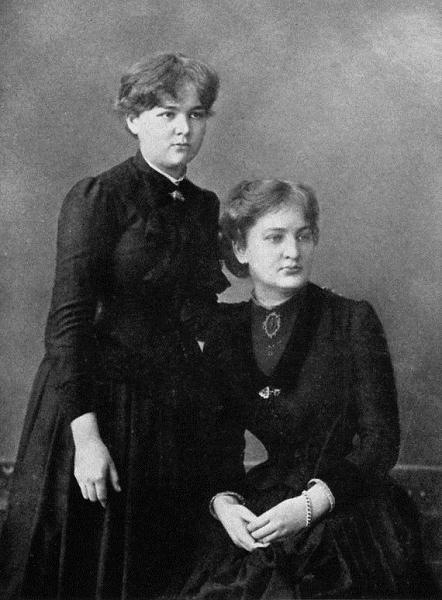
11 月 7 日生於沙俄占領下的 Warsaw。原名 Maria Salomea Skłodowska——5 子最小女兒。父 Władysław 是物理數學教師、被沙俄當局降職因親波蘭立場。家裡擺著父親在學校教書沒收的物理儀器,小 Maria 從小受其薰陶。
Born November 7 in Warsaw under Russian rule. Birth name Maria Salomea Skłodowska — the youngest of five. Father Władysław was a physics and math teacher, demoted by the Russian authorities for his Polish nationalist views. The family had physics instruments at home that her father had brought back when his school confiscated them — little Maria grew up among them.
At 10 her mother Bronisława died of tuberculosis. Her mother had been a devout Catholic; Maria abandoned the faith and turned to positivism — only what can be empirically proved. The same year her eldest sister Zofia also died. The double blow shaped her lifelong pure devotion to science.
沙俄禁波蘭女性上正規大學。Maria 加入秘密的「Uniwersytet Latający (飛行大學)」——夜晚地下教室、女學生輪流躲警察、教授義務上課。同時做 8 年女家教存錢供姐 Bronia 赴 Paris 學醫——之後輪到自己赴法。是堅韌與姊妹情深的象徵。
The Russian regime banned Polish women from regular university. Maria joined the secret "Uniwersytet Latający" (Flying University) — underground classrooms at night, women students rotating to dodge police, professors teaching for free. Meanwhile she worked eight years as a governess to fund her sister Bronia's medical studies in Paris — on the agreement that her turn would come next. A symbol of grit and sisterly devotion.
In November, at 24, she traveled fourth-class to Paris and enrolled in physics at the Sorbonne. She lived in an attic in the Latin Quarter — in winter, to save coal, she wore all her clothes to bed and still shivered; she fainted from hunger in the library more than once. In three years she graduated first in her class with a physics degree, and the next year added a math degree.
Introduced by a mutual friend in 1894, Marie met the 35-year-old Pierre Curie — already famous for discovering piezoelectricity, head of physics at the Sorbonne. On their first walk they talked about magnetism research. Pierre wrote her: "It would be a beautiful thing to pass our lives near each other, hypnotized by our dreams." They married in 1895 — no wedding gown (Marie wore a practical dark-blue suit that became her lab uniform), no banquet, a bicycle honeymoon.
Pitchblende 殘渣·人手 8 噸提鐳釙Pitchblende — 8 Tons Hand-Processed for Radium
圖:https://wellcomeimages.org/indexplus/obf_images/b7/7d/0fdedbd7465b85ef124e289c33 · CC BY 4.0 · Wikimedia CommonsImage: https://wellcomeimages.org/indexplus/obf_images/b7/7d/0fdedbd7465b85ef124e289c33 · CC BY 4.0 · Wikimedia Commons
Becquerel discovered uranium's "radioactivity" (Marie's word) in 1896. Marie measured many minerals and found pitchblende was more radioactive than pure uranium — there must be an unknown element. The Sorbonne gave them a leaking shed for a lab. Pierre and Marie processed eight tons of pitchblende residues by hand — boiling in giant pots, stirring, crystallizing — for four years, to extract 0.1 grams of radium chloride.
7 月與 Pierre 發表第一個新元素發現——「Polonium (釙)」,紀念當時被沙俄、奧匈、普魯士三分割的祖國 Poland。極具政治意涵——是科學史上第一次以政治理由命名元素。Polonium 比鈾放射性高 400 倍。
In July she and Pierre announced the discovery of a new element — "polonium," named for her partitioned homeland Poland (then split among Russia, Austria-Hungary, and Prussia). Politically charged — the first time in history an element was named for a country existing only as a political idea. Polonium is 400 times more radioactive than uranium.
In December, with Pierre and chemist Bémont, she announced a second new element — "radium" (Latin radius, ray). Radium is a million times more radioactive than uranium. Marie later wrote: "Our precious little ones at night gave off a faint, magical blue glow — they were our delight." They did not know the beautiful blue glow was killing them.
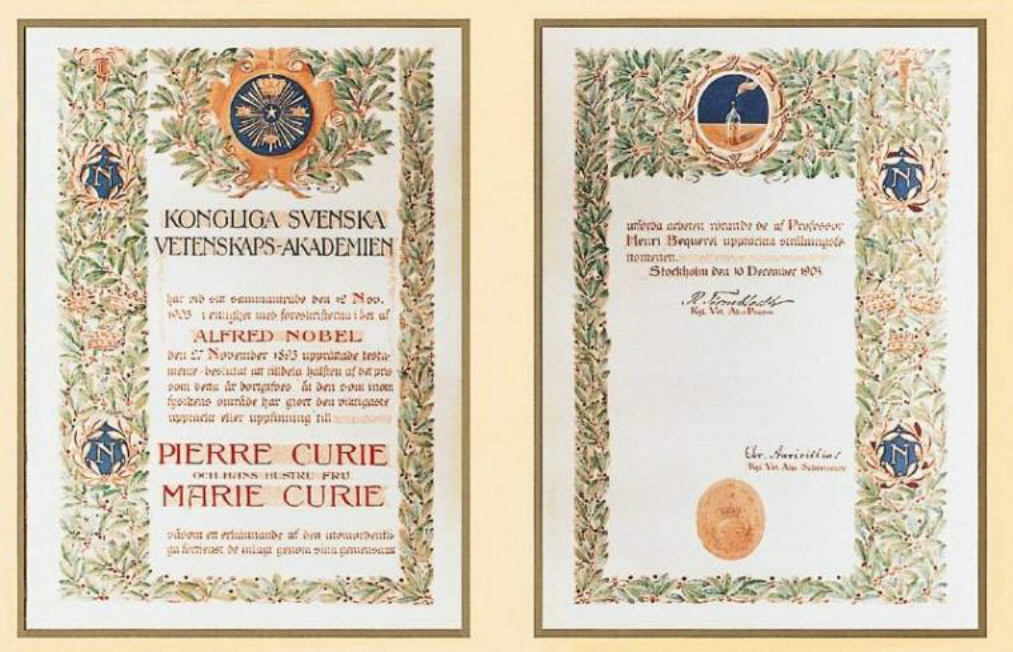
與 Pierre Curie 與 Becquerel 共獲 Nobel 物理獎——表彰放射性研究。原計畫只授予 Pierre 與 Becquerel——是 Pierre 堅持、Marie 才被列入。Marie 是有史以來第一位獲 Nobel 獎的女性。獎金 70000 法郎讓兩人首次擺脫貧困——但他們把大部分捐回實驗室。
With Pierre Curie and Henri Becquerel she won the Nobel Prize in Physics — for the discovery of radioactivity. The committee originally planned to award only Pierre and Becquerel — only Pierre's insistence got Marie included. She became the first woman ever to win a Nobel Prize. The 70,000-franc purse lifted them out of poverty for the first time — most of which they donated back to research.
4 月 19 日 Pierre 在巴黎雨中過 rue Dauphine、被馬車輾過、頭骨破裂當場死亡。46 歲。Marie 心碎到難以承受、寫日記給 Pierre:「我的 Pierre、我等你回家、我準備好告訴你今天我有多想你。」終身穿黑、女兒 Eve 形容母親「從那天起再無快樂」。
On April 19, Pierre was crossing the rue Dauphine in Paris in the rain — a horse-drawn carriage ran him over and crushed his skull, killing him instantly. He was 46. Marie was shattered, writing in her journal addressed to Pierre: "My Pierre, I am waiting for you, I am ready to tell you how much I missed you today." She wore black for life. Her daughter Ève wrote that her mother "never again knew happiness."
接 Pierre 教授職·Sorbonne 第一位女教授Takes Pierre's Chair — First Woman Professor at the Sorbonne
圖:This file was contributed to Wikimedia Commons by Science History Institute as p · Public domain · Wikimedia CommonsImage: This file was contributed to Wikimedia Commons by Science History Institute as p · Public domain · Wikimedia Commons
5 月 13 日 Sorbonne 任命 Marie 接 Pierre 的物理教授位——成為 Sorbonne 650 年歷史上第一位女教授。第一堂課她從 Pierre 上次停下的句子開始講起、無一字哀悼、無一聲啜泣——全場學生屏息。她拒絕當時通常的悼念儀式:「沒時間。」
On May 13 the Sorbonne appointed Marie to Pierre's physics chair — making her the first woman professor in the university's 650-year history. Her first lecture began with the sentence Pierre had ended on — not one word of mourning, no tears — the auditorium held its breath. She refused all conventional funeral observance: "There is no time."
5 年喪夫後 Marie 與 Pierre 學生、已婚的 Paul Langevin 戀愛——Langevin 妻子拿到他們情書威脅公開。1911 年 11 月確實在報紙公開、引發全國醜聞——「波蘭女人勾引法國丈夫」。媒體圍攻 Marie 家、丟石頭、寄威脅信。Marie 帶女兒躲到友人家——同月被告知獲第二次 Nobel。
Five years after Pierre's death Marie fell in love with Paul Langevin — Pierre's former student, married. His wife seized their love letters and threatened to publish. In November 1911 they were published in the press — a national scandal: "the Polish woman seducing a French husband." Reporters mobbed her house, threw stones, sent threats. Marie hid with her daughters at a friend's house — and that very month was told she had won her second Nobel.
12 月再獲 Nobel 化學獎——表彰分離出純鐳金屬。她是史上第一個拿兩次 Nobel 的人、至今唯一同時獲物理與化學雙領域 Nobel 者 (Linus Pauling 是化學+和平、Bardeen 是兩次物理)。但 Langevin 緋聞當下 Nobel 委員會 (Svante Arrhenius) 來信暗示她不要去領獎——「醜聞之中前來 Stockholm 不合適」。Marie 強硬回信:「Nobel 獎是給科學成就,不是給私人生活。」——堅持赴瑞典領獎。
In December she received the Nobel Prize in Chemistry — for isolating pure metallic radium. She became the first person ever to win two Nobels, and to this day the only one with Nobels in two different sciences (Linus Pauling won Chemistry and Peace; Bardeen won Physics twice). But amid the Langevin scandal, the Nobel Committee (Svante Arrhenius) wrote suggesting she stay home — "it would be inappropriate to come to Stockholm in the midst of scandal." Marie's reply was firm: "The Nobel Prize is awarded for scientific work, not for private life." She went to Sweden and accepted it.
創 Paris Radium Institute·終身基地Founds the Radium Institute in Paris — Her Final Base
圖:This file was contributed to Wikimedia Commons by Science History Institute as p · Public domain · Wikimedia CommonsImage: This file was contributed to Wikimedia Commons by Science History Institute as p · Public domain · Wikimedia Commons
1914 巴黎 Sorbonne 與 Pasteur Institute 聯合創立 Institut du Radium——含物理化學部 (Marie 主管) 與生物學部 (用鐳治癌)。是世界第一個放射性研究中心、Marie 終身基地。今日仍存、改名 Institut Curie——歐洲頂尖癌症研究機構之一、4 位 Nobel 獎得主出於此。
In 1914 the Sorbonne and the Pasteur Institute jointly founded the Institut du Radium — with a physics-chemistry section under Marie and a biology section developing radium cancer therapy. The world's first radioactivity research center, Marie's base for the rest of her life. Today it still exists, renamed the Institut Curie — one of Europe's top cancer research centers, four Nobel laureates have worked there.
WWI 爆發 Marie 立刻發明戰地行動 X 光車——把 X 光機裝小貨車、開上前線、讓醫師當場拍片找彈片。她親自開車到前線、親自操作機器。整 4 年戰爭中她與長女 Irène 訓練 150 名女技師、20 輛「Petite Curies」服務了百萬以上士兵。但她拒收法國政府獎章——「我做的事是公民義務」。
At the outbreak of WWI Marie immediately invented the mobile battlefield X-ray van — mounting an X-ray machine in a small truck, driving it to the front, letting doctors locate shrapnel on the spot. She drove the trucks herself and operated the machines herself. Over four years she and her elder daughter Irène trained 150 female technicians; 20 "Petites Curies" served over a million soldiers. She refused all decorations from the French government — "this was simply a citizen's duty."
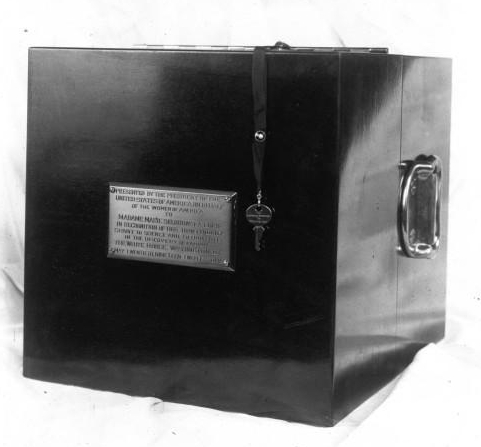
1921 年美國雜誌記者 Marie Mattingly Meloney 採訪 Marie、發現法國 Marie 缺鐳做研究 (一克鐳當時 10 萬美元、相當於今 150 萬)。Meloney 發起全美婦女小額募款、5 月籌足 10 萬美元。Marie 與兩女赴美 7 週、Harding 總統親自頒鐳給她。沿途受英雄式歡迎——但 Marie 行程過密差點 collapse。
In 1921 the American journalist Marie Mattingly Meloney interviewed Marie and discovered she lacked the radium to continue research (one gram cost $100,000 — about $1.5 million today). Meloney launched a small-donation drive among American women across the country and by May had raised $100,000. Marie and her two daughters toured the US for seven weeks; President Harding personally presented her with the gram of radium. She was hailed as a hero — but the punishing schedule nearly broke her.
圖:https://wellcomeimages.org/indexplus/obf_images/b7/7d/0fdedbd7465b85ef124e289c33 · CC BY 4.0 · Wikimedia CommonsImage: https://wellcomeimages.org/indexplus/obf_images/b7/7d/0fdedbd7465b85ef124e289c33 · CC BY 4.0 · Wikimedia Commons
Her health collapsed quickly in her last years — cataracts (four surgeries), extreme fatigue, repeated infections. In spring 1934 she was diagnosed with aplastic anemia — her bone marrow had stopped making blood. The cause is universally attributed to years of carrying radium tubes in her pockets and lab coat, compounded by WWI X-ray exposure. To the end she refused to acknowledge that radium had killed her, defending her "beautiful blue light" all her life.
7 月 4 日死於法國阿爾卑斯山 Sancellemoz 療養院,66 歲。葬於南巴黎 Sceaux 與 Pierre 同墓。她實驗室與筆記本至今放射性極強——所有 Marie Curie 文件存放在巴黎國家圖書館鉛盒中、需要簽放射性免責書才能查閱、預估再 1500 年才會降到安全程度。
She died at the Sancellemoz sanatorium in the French Alps on July 4 at age 66. She was buried at Sceaux south of Paris with Pierre. Her laboratory and notebooks remain so radioactive that all Marie Curie papers at the Bibliothèque Nationale in Paris are kept in lead boxes, requiring a signed radiation waiver to consult — estimated to remain dangerous for another 1,500 years.
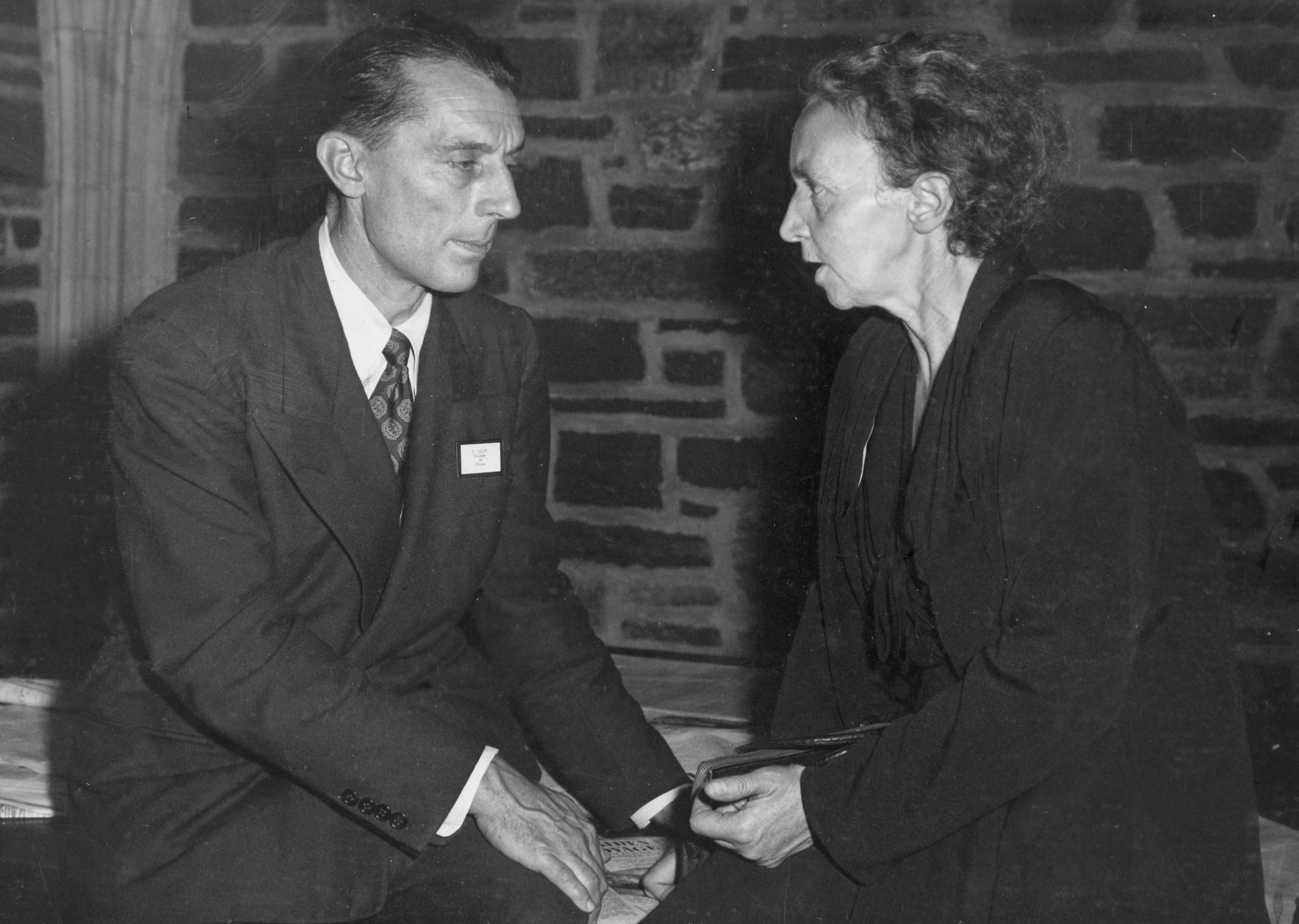
Marie 死後一年,1935 年長女 Irène Joliot-Curie 與丈夫 Frédéric Joliot 共獲 Nobel 化學獎——表彰人工放射性的發現。Marie 一家是史上唯一「母親+女兒」皆得 Nobel 科學獎的家族。Irène 1956 年也因再生不良性貧血 (放射性病) 死亡——58 歲。次女 Eve 不入科學界、寫了著名母親傳記《Madame Curie》(1937 出版、Hollywood 1943 拍成電影)。
A year after Marie's death, in 1935, her elder daughter Irène Joliot-Curie and her husband Frédéric Joliot won the Nobel in Chemistry for the discovery of artificial radioactivity. The Curies are the only family in history with both a mother and daughter winning Nobel science prizes. Irène also died of aplastic anemia (radiation disease) in 1956 — at 58. The younger daughter Ève did not enter science, but wrote the famous biography Madame Curie (1937, made into a 1943 Hollywood film).
1995 年 Mitterrand 總統下令把 Marie 與 Pierre 的遺骨從 Sceaux 遷入巴黎 Panthéon——法國國家英雄安息地。Marie 成為第一位以自己功績被葬入 Panthéon 的女性 (此前唯一女性是 Sophie Berthelot 是陪丈夫入葬)。儀式上 Mitterrand 演講:「她示範了女性可以與男性同等改變人類進程。」她與 Pierre 的鉛襯棺木並列。
In 1995 President Mitterrand ordered Marie and Pierre's remains transferred from Sceaux to the Panthéon in Paris — France's resting place for national heroes. Marie became the first woman buried there for her own merit (the only previous woman, Sophie Berthelot, had been interred only as her husband's spouse). Mitterrand declared at the ceremony: "She showed that a woman, by her own achievements, can change the course of human progress." Her lead-lined coffin lies beside Pierre's.