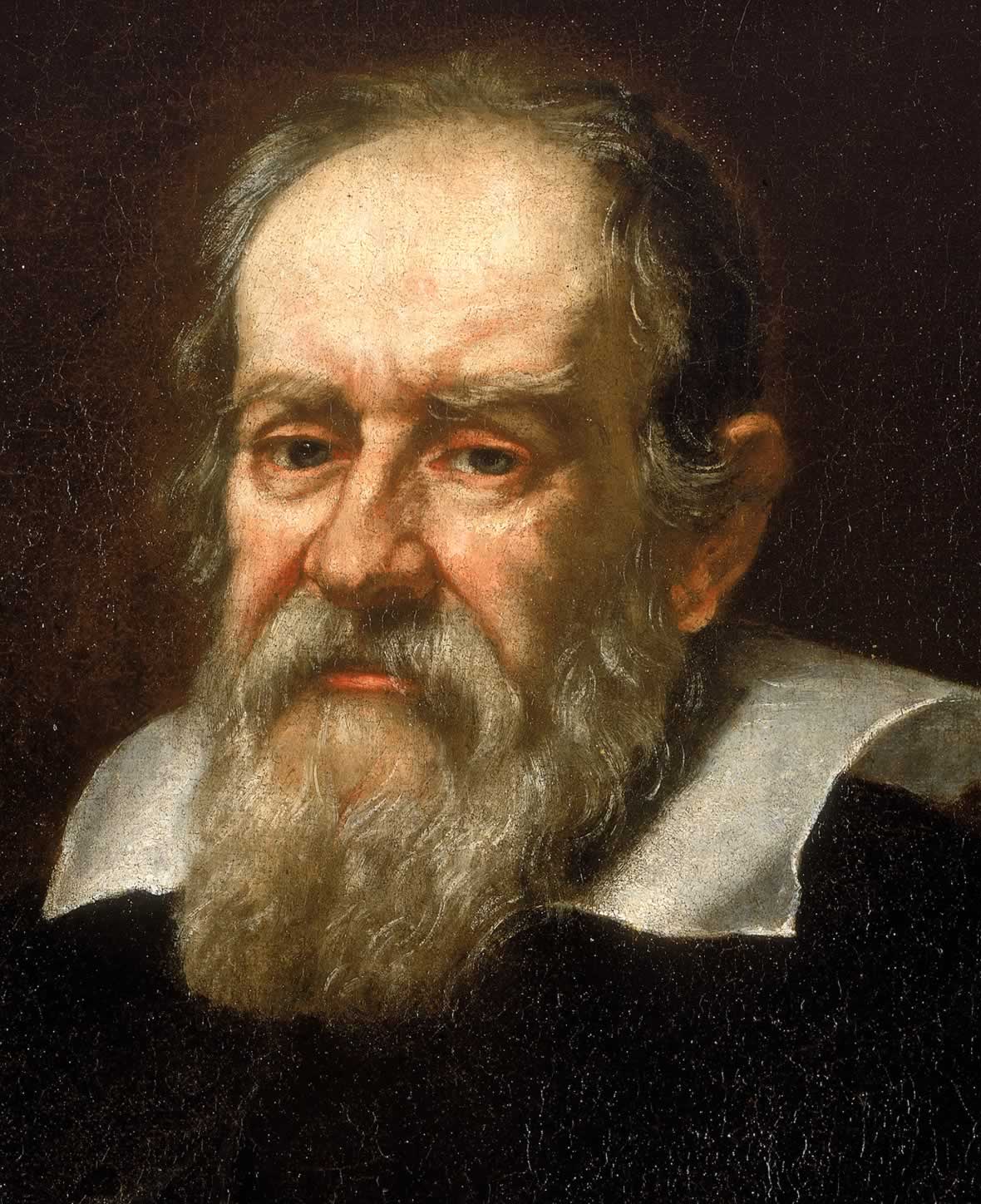
Born in Pisa the year Michelangelo died, dying at Arcetri the year Newton was born. At 19 watching a cathedral lamp swing he discovered pendulum isochronism; at 25 the legendary balls from the Leaning Tower; improving the Dutch telescope he saw Jupiter's moons, the Moon's mountains, the phases of Venus, sunspots — shattering Aristotelian cosmology. In 1633 he knelt and abjured heliocentrism; legend says rising he muttered "And yet it moves." Permanent house arrest. Blind in old age, he smuggled the Two New Sciences to Holland — founding Newtonian mechanics. The Church rehabilitated him 359 years later (1992). His middle finger, hidden as a relic for two centuries, today points at the sky in the Florence museum.
📌 內容與授權:本頁事件說明文字(中英)為 Cosmic History Timeline 編輯整理。
圖片來自 Wikimedia Commons,作者與授權詳見每張圖下方連結。
延伸閱讀的 Wikipedia 與 Amazon 連結著作權歸原權利人;Amazon 連結為聯盟連結(不影響你的價格)。
📌 Sources & Credits: Event descriptions (zh / en) are editorial work by Cosmic History Timeline.
Images are sourced from Wikimedia Commons — author and license shown below each image.
Wikipedia and Amazon links belong to their respective rights holders; Amazon links are affiliate links (no extra cost to you).
1560 – 1585 · 3 條事件1560 – 1585 · 3 events
1564 年culture
出生 Pisa·米開朗基羅死當年Born in Pisa — The Year Michelangelo Died
2 月 15 日出生 Pisa。父親 Vincenzo Galilei 是知名作曲家與音樂理論家、實驗派音樂學者——對伽利略後來實驗精神有深遠影響。家境清寒、長子。
Born February 15 in Pisa. His father Vincenzo Galilei was a renowned composer and music theorist who experimented with vibrating strings — instilling in young Galileo an experimental cast of mind. The family was poor; he was the eldest son.
Born in Pisa the year Michelangelo died, died at Arcetri the year Newton was born. Improving the telescope, he discovered Jupiter's moons, mountains on the Moon, the phases of Venus, sunspots — overturning the astronomy of Aristotle and Ptolemy. In 1633 the Inquisition tried him for defending heliocentrism; he knelt to recant and was placed under permanent house arrest. Blind in his last years, he still smuggled the Two New Sciences out to Holland — founding modern mechanics. Officially rehabilitated by Pope John Paul II in 1992. Einstein called him "the father of modern science."
At 19, attending Mass in the Pisa Cathedral, he watched a bronze lamp swing after a priest had pushed it. Timing the swings against his own pulse, he realized the period stayed constant regardless of amplitude — the isochronism of the pendulum. He later designed a pulsometer and conceived the pendulum clock (though never built one in his lifetime).
Legend says that as a 25-year-old mathematics professor at the University of Pisa, Galileo dropped balls of different weight from the Leaning Tower, proving that — contrary to Aristotle — heavy and light objects fall at the same rate. The story comes from his student Vincenzo Viviani's biography (1654); no contemporary record confirms it. But Galileo did precisely measure acceleration using inclined planes in his Padua years.
After leaving Pisa, he became professor of mathematics at Padua for 18 years — he later called these his "happiest years." Padua was in the Venetian Republic, far from papal interference. He studied motion, built military compasses, signed his name "Galileo Galilei Fiorentino" (with patriotic pride), and lived with his mistress Marina Gamba — three children (two daughters sent to a convent, the son kept).
In 1608 the Dutch spectacle-maker Hans Lippershey patented the telescope. Hearing of it in 1609, Galileo built an improved version overnight — longer focal length, magnification leaping from 3× to 30×. He first sold it to the Venetian Senate for spotting ships at sea (and a salary boost), then turned it to the heavens. Within a year, his cascade of famous astronomical discoveries began.
Galileo improves the telescope and turns it skyward; discovers Jupiter's moons and Venus phases; defends heliocentrism with experiment, founding modern science.
相關主軸:Related axes:科學技術Science & Tech伽利略Galileo Galilei
In January, Galileo used his telescope to discover Jupiter's four moons, lunar mountains, Venus phases, and millions of Milky Way stars. In March he published 'Sidereus Nuncius' (Starry Messenger), empirically supporting heliocentrism and shaking the Aristotelian cosmos.
觀月見山谷火山口·月非完美球Observes the Moon — Mountains and Craters, Not a Perfect Sphere
圖:https://wellcomeimages.org/indexplus/obf_images/b6/b2/9652d81860bd0616db81f10e89 · CC BY 4.0 · Wikimedia CommonsImage: https://wellcomeimages.org/indexplus/obf_images/b6/b2/9652d81860bd0616db81f10e89 · CC BY 4.0 · Wikimedia Commons
Through the telescope he observed the Moon and drew the first detailed lunar maps. He saw mountains, craters, and plains — not the perfect smooth sphere of Aristotelian cosmology. He inferred that the Moon was made of the same kind of matter as Earth — the first observational evidence that heaven and earth might share one physics. The 2,000-year-old Aristotelian cosmos began to crack.
發現木星四衛星·Medicean StarsDiscovers Four Moons of Jupiter — "The Medicean Stars"
圖:Scan: History of Science Collections, University of Oklahoma Libraries
Original: · Public domain · Wikimedia CommonsImage: Scan: History of Science Collections, University of Oklahoma Libraries
Original: · Public domain · Wikimedia Commons
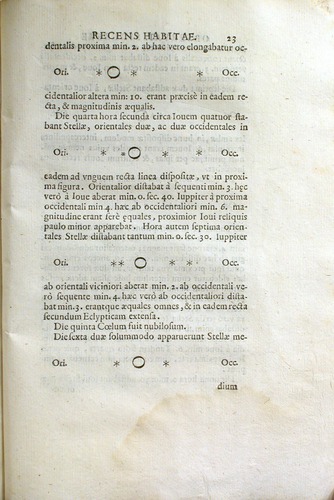
Over seven consecutive nights from January 7 to 13, he observed Jupiter and noticed four "little stars" changing position — and confirmed they were satellites orbiting Jupiter (today Io, Europa, Ganymede, and Callisto). The first discovery in history of moons orbiting another body — direct proof that not everything orbits Earth. To curry favor with Cosimo II de' Medici, he named them "the Medicean Stars."
3 月《Sidereus Nuncius (星際信使)》在威尼斯出版——60 頁拉丁文小冊子、含月面圖、木星衛星觀測。一夜在歐洲風行——Pope Paul V、Henri IV、Kepler、開普勒皆來信祝賀。Cosimo II Medici 立刻召他回 Tuscany 任宮廷數學家——薪水翻倍、不必教學。
In March, Sidereus Nuncius ("Starry Messenger") was published in Venice — a 60-page Latin pamphlet with moon maps and Jupiter observations. Overnight it swept Europe; congratulations poured in from Pope Paul V, Henri IV, Kepler. Cosimo II de' Medici immediately recalled him to Tuscany as court mathematician — double pay, no teaching duties.
Late in the year he discovered that Venus, like the Moon, has phases — from crescent through full. This could only happen if Venus orbited the Sun and passed both between and beyond it from Earth. Ptolemy's system (Venus always between Earth and Sun) predicted only crescent shapes — the observation refuted it absolutely. The strongest astronomical evidence yet for heliocentrism.
用「投影法」(camera obscura) 觀太陽 (避免燒眼)。連續記錄黑子位置變化,發現太陽自轉週期 25-30 天。再次違背 Aristotle「天體完美無瑕」教義。與耶穌會學者 Christoph Scheiner 為「誰先發現」爭論——播下日後教廷敵意的種子。
Using projection (camera obscura) to view the Sun safely, he tracked sunspots and determined the Sun rotates with a period of 25-30 days. Once again contradicting Aristotelian doctrine that celestial bodies are perfect and immutable. He fought with the Jesuit astronomer Christoph Scheiner over priority of discovery — sowing seeds of his later trouble with the Church.
耶穌會與 Dominican 修士向教廷舉發伽利略「異端」。Pope Paul V 命 Cardinal Bellarmine 召見伽利略:哥白尼日心說可作為「假設」討論、但不可宣稱為「物理事實」。伽利略形式上同意。同時哥白尼《天體運行論》被列禁書 (直到 1835)。
Jesuits and Dominicans denounced Galileo to the Inquisition for heresy. Pope Paul V sent Cardinal Bellarmine to interview Galileo: heliocentrism could be discussed as a hypothesis, but not asserted as physical fact. Galileo formally agreed. Copernicus's De revolutionibus was placed on the Index of Forbidden Books — where it stayed until 1835.
歷時 6 年完成義大利文《Dialogue》——三人對話:Salviati (日心說)、Sagredo (中立)、Simplicio (地心說笨蛋)。明顯偏袒日心說。新 Pope Urban VIII (原本伽利略朋友) 大怒——他懷疑 Simplicio 影射自己。教廷召伽利略到羅馬受審。
After six years he published the Italian-language Dialogue — three voices: Salviati (heliocentrist), Sagredo (neutral), and Simplicio (geocentrist fool). The bias was obvious. The new Pope Urban VIII — once Galileo's friend — was furious, suspecting that Simplicio caricatured him. He summoned Galileo to Rome for trial.
圖:Joseph-Nicolas Robert-Fleury · Public domain · Wikimedia CommonsImage: Joseph-Nicolas Robert-Fleury · Public domain · Wikimedia Commons
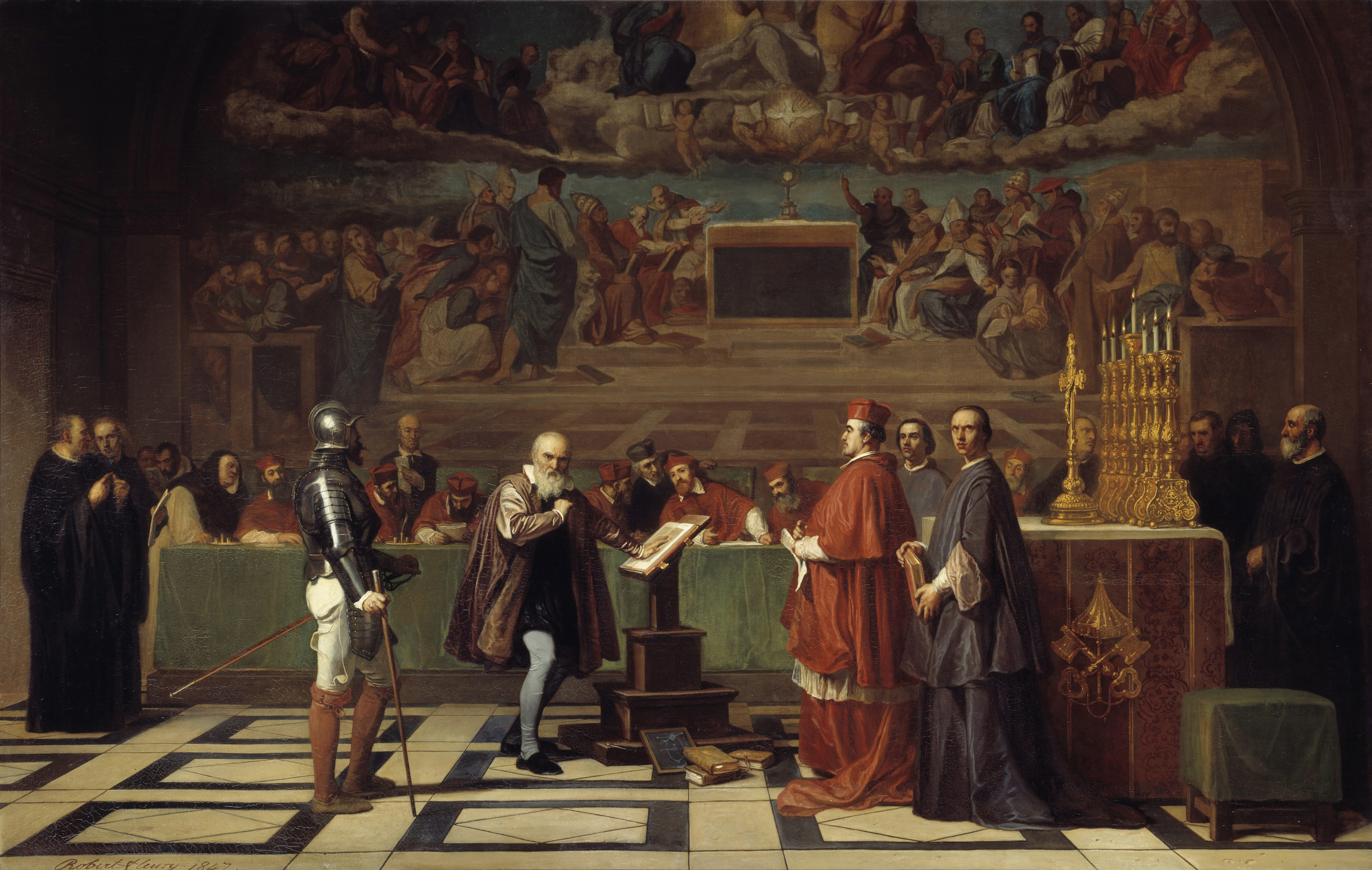
6 月 22 日羅馬宗教裁判所判 Galileo 異端,被迫公開放棄日心說(傳說中喃喃「Eppur si muove」「但它還是動的」),餘生軟禁。1992 年教宗 John Paul 二世正式為 Galileo 平反。
On June 22, the Roman Inquisition convicted Galileo of heresy, forcing him to publicly recant heliocentrism (legend has him muttering 'Eppur si muove' — 'And yet it moves'). He spent his final years under house arrest. Pope John Paul II formally rehabilitated him in 1992.
From April he faced four interrogations before the Roman Inquisition. He was 70, frail, ill. They produced the 1616 warning document. He was told that if he did not confess he would face "rigorous examination" (the implied threat of torture). He agreed to admit "overzealous argumentation for heliocentrism," but refused to admit heretical intent. The verdict: "vehemently suspect of heresy."
圖:https://wellcomeimages.org/indexplus/obf_images/10/6d/ed1d2d74266a90f06ae1ec6c63 · CC BY 4.0 · Wikimedia CommonsImage: https://wellcomeimages.org/indexplus/obf_images/10/6d/ed1d2d74266a90f06ae1ec6c63 · CC BY 4.0 · Wikimedia Commons
The sentence: life imprisonment, commuted by the Pope to house arrest in Tuscany. He spent his last nine years at his villa at Arcetri outside Florence. His daughter Maria Celeste (a nun) cared for him; 124 of her letters survive (the basis of the book Galileo's Daughter). Maria Celeste died young in 1634; Galileo wrote that he was "pierced through the heart."
6 月 22 日於 Santa Maria sopra Minerva 教堂跪地、穿懺悔白衣、誦讀放棄日心說的拉丁誓詞:「我跪認、誓棄、詛咒並譴責上述的錯誤與異端」。傳說起身時喃喃自語:「Eppur si muove (但它仍在動)」——但這句話 18 世紀才出現於史書,可能是後人浪漫化加上。
On June 22, in the church of Santa Maria sopra Minerva, kneeling in a penitent's white robe, he read aloud the Latin abjuration: "I, Galileo, on my knees, abjure, curse, and detest the said errors and heresies." Legend says that as he rose he muttered "Eppur si muove" — "And yet it moves." But this phrase first appears in an 18th-century biography; it may be a romantic later embellishment.
全盲·「我探索的天空現在永遠暗了」Blind — "The Heavens I Explored Are Now Forever Dark"
圖:unknown. One of its former owners had attributed it to Bartolomé Esteban Murillo · Public domain · Wikimedia CommonsImage: unknown. One of its former owners had attributed it to Bartolomé Esteban Murillo · Public domain · Wikimedia Commons
At 74 he went totally blind — the cost of years of filterless observation of sunspots. He wrote to a friend: "This universe, which I expanded a thousand times by my discoveries, is now shrunk into my own person, and grows dark forever."
晚年 (失明後) 完成《Discourses on Two New Sciences》。內容是力學基礎——慣性、自由落體、拋物線、材料強度。教廷禁書,伽利略偷將手稿經外交郵袋送到新教荷蘭 Leiden 出版。這本書是牛頓力學的直接前驅——50 年後牛頓 1687 年的《Principia》直接立基於此。
In his blind old age he completed the Discourses on Two New Sciences — the foundations of mechanics: inertia, free fall, projectile motion, the strength of materials. Forbidden in Catholic lands, Galileo smuggled the manuscript via diplomatic pouch to Protestant Holland, published at Leiden. This book was the direct precursor to Newtonian mechanics — Newton's Principia of 1687 built directly on it.
1 月 8 日死於 Arcetri 別墅,77 歲。同年 12 月 25 日 Isaac Newton 在英國出生——科學史上「火炬交接」的傳奇巧合。Pope Urban VIII 拒絕讓伽利略葬聖十字大教堂主殿。1737 年才被遷入主殿,與米開朗基羅、Machiavelli 並列。
Died January 8 at the Arcetri villa, age 77. On December 25 the same year Isaac Newton was born in England — the legendary "passing of the torch." Pope Urban VIII refused him burial in the main hall of Santa Croce in Florence; only in 1737 were his bones moved there, beside Michelangelo and Machiavelli.
During the 1737 reburial at Santa Croce, an admirer cut off Galileo's right middle finger as a secular relic (a pointed counter to the Church's persecution). The finger was hidden for over 200 years; today it stands in the Museo Galileo in Florence — pointing toward the sky, a wordless gesture of "I pointed at truth."
In 1979 Pope John Paul II ordered a reexamination of the Galileo case. After 13 years of study, on October 31, 1992, the Pope formally acknowledged at the Vatican that the theologians of 1633 had erred in using scripture to interpret science; Galileo had suffered unjustly. 359 years after his abjuration. By then humans had walked on the Moon, and his "Medicean Stars" had been photographed up close by Voyager.