Played piano at 3, composed at 5, performed for the Empress at 6 — jumped on her knee to kiss her, proposed marriage to her daughter Marie Antoinette. At 14 he wrote down from memory the Vatican's forbidden Allegri Miserere. Kicked out of the Salzburg Archbishop's service in literal disgrace, he settled in Vienna. Figaro, Don Giovanni, The Magic Flute. A stranger in grey commissioned the Requiem; Mozart, dying, finished only half. Dead at 35, buried in a common grave; his bones never identified. The Salieri poisoning story is myth — but the 1984 film Amadeus made it global.
📌 內容與授權:本頁事件說明文字(中英)為 Cosmic History Timeline 編輯整理。
圖片來自 Wikimedia Commons,作者與授權詳見每張圖下方連結。
延伸閱讀的 Wikipedia 與 Amazon 連結著作權歸原權利人;Amazon 連結為聯盟連結(不影響你的價格)。
📌 Sources & Credits: Event descriptions (zh / en) are editorial work by Cosmic History Timeline.
Images are sourced from Wikimedia Commons — author and license shown below each image.
Wikipedia and Amazon links belong to their respective rights holders; Amazon links are affiliate links (no extra cost to you).
Played piano at 3, composed at 5, performed for the Empress of Austria at 6. Father Leopold toured Europe with him for ten years. At 28 he peaked in Vienna — The Marriage of Figaro, Don Giovanni, The Magic Flute. Dead at 35 of an unidentified fever, buried in a common grave — his bones never identified. 600+ works, Köchel catalog K.1 to K.626, the Requiem unfinished.
出生 Salzburg·父親是樂師Born in Salzburg — Son of a Court Musician
圖:Jonathanawhite at English Wikipedia · Public domain · Wikimedia CommonsImage: Jonathanawhite at English Wikipedia · Public domain · Wikimedia Commons
Born January 27 in Salzburg. Father Leopold Mozart was a court violinist in the Archbishop's orchestra and author of a famous violin treatise. Of seven children, only two survived — Wolfgang and his sister Nannerl, five years older.
At 3, listening to his sister's lessons, he climbed to the keyboard and found harmonious thirds. By 4 he played short pieces, by 5 he was composing — his father wrote down a little minuet (K.1). Even Bach's musical son J.C. Bach had not started three generations earlier so young.
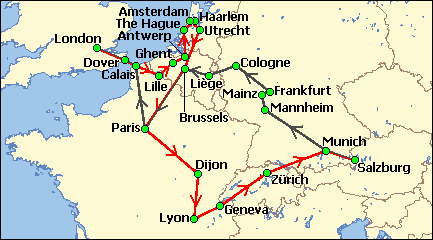
6 歲被父親帶上歐洲巡演——慕尼黑、Vienna 為奧地利女皇 Maria Theresa 演奏 (傳說小 Mozart 跳上她膝蓋親吻、向她公主 Marie Antoinette 求婚)、巴黎為 Louis XV 演奏、倫敦為 George III 演奏 15 個月、Hague、巴黎再次。整 4 年都在馬車上。
At 6 his father took him on a four-year European tour — Munich, then Vienna where he played for Empress Maria Theresa (legend says little Mozart jumped on her knee to kiss her and proposed marriage to her daughter Marie Antoinette), Paris for Louis XV, London 15 months for George III, then The Hague, then Paris again. Four years on the road in carriages.
In the Sistine Chapel he heard Allegri's Miserere — a Vatican secret, forbidden to be copied under pain of excommunication. Mozart returned to his lodgings and wrote out the entire score from memory, then heard it once more to make small corrections. The Pope, instead of punishing him, awarded him the Order of the Golden Spur.
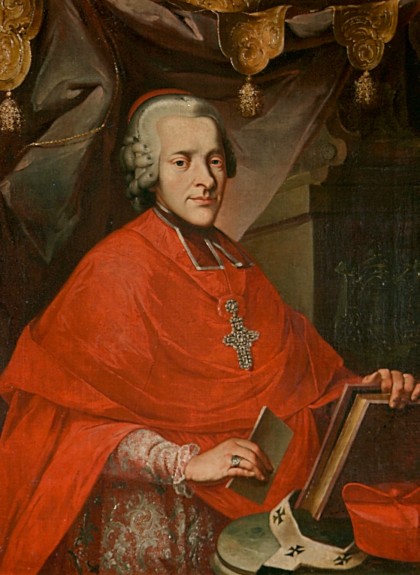
At 17 hired as court musician to Archbishop Colloredo of Salzburg. Pay was low (150 gulden a year), he was treated as a servant, dined at the table of cooks. He wrote symphonies, masses, and his five violin concertos. Father and son disagreed — Leopold wanted the stable income; Mozart wanted bigger stages.
22 歲與母親 Anna Maria 赴 Paris 找工作。法國音樂界冷淡、無重大職位。7 月 3 日母親病死於 Paris 寓所、Mozart 獨自處理喪事。他不敢直接告知父親、寫信時只說「母親病重」、隔幾天再說「她已死」。
At 22 he traveled with his mother Anna Maria to Paris to find a position. The French music establishment was cool; no major post offered. On July 3 his mother died of illness in their Paris lodgings; Mozart handled the funeral alone. He could not bear to tell his father directly — he wrote saying she was "gravely ill," then days later that she had died.
At 25 his row with the Archbishop of Salzburg climaxed — legend says the Archbishop's chamberlain Count Arco kicked him out of the palace by the seat of his pants. Free, Mozart settled in Vienna. Leopold scolded him from Salzburg for the recklessness — but this began the freest years of Mozart's life.
7 月《後宮誘逃》(土耳其風德語歌劇) 首演。皇帝 Joseph II 評:「太多音符了,親愛的 Mozart。」Mozart 答:「正好是該有的數量,陛下。」全 Vienna 風行,他成 Vienna 最受歡迎作曲家。
In July, the Turkish-themed German opera Die Entführung aus dem Serail premiered. Emperor Joseph II remarked: "Too many notes, my dear Mozart." Mozart replied: "Exactly the necessary number, Your Majesty." The opera swept Vienna; he became the city's most popular composer.
He had first fallen for the singer Aloysia Weber, who rejected him; lodging with the Weber family, he ended up marrying her sister Constanze. Father Leopold gave grudging consent only the day before the wedding. Of their six children, only two survived. Loving but impractical with money, Constanze was his companion to the end — when Mozart died he was deeply in debt.
Mozart formed a deep friendship with Haydn, 24 years older. Mozart dedicated six string quartets to him. Haydn said to Leopold: "Before God and as an honest man, I tell you that your son is the greatest composer known to me either in person or by name. He has taste, and the most thorough knowledge of composition." Haydn was among the few who recognized Mozart's genius from the start.
《費加洛婚禮》·與 da Ponte 合作The Marriage of Figaro — Collaboration with Da Ponte
圖:Michele Pekenino (engraver, 19th century) after Nathaniel Rogers (American, 1788 · Public domain · Wikimedia CommonsImage: Michele Pekenino (engraver, 19th century) after Nathaniel Rogers (American, 1788 · Public domain · Wikimedia Commons
5 月 1 日《Le Nozze di Figaro》在 Vienna 首演。劇本由前神父 Lorenzo da Ponte 改編 Beaumarchais 革命前夕的政治劇——僕人智勝貴族。皇帝原想禁但被 Mozart 求情過關。維也納反應冷淡、布拉格瘋狂熱愛——Mozart 寫信:「布拉格人這裡都在唱費加洛!」
On May 1 Le Nozze di Figaro premiered in Vienna. Librettist Lorenzo da Ponte (a former priest) had adapted Beaumarchais's pre-revolutionary play — servants outwitting nobles. Emperor Joseph II had wanted to ban it; Mozart talked him round. Vienna responded coolly, but Prague went wild. Mozart wrote: "Here in Prague everyone is singing Figaro!"
圖:Postal administration of the Protectorate of Bohemia and Moravia · Public domain · Wikimedia CommonsImage: Postal administration of the Protectorate of Bohemia and Moravia · Public domain · Wikimedia Commons
10 月 29 日《Don Giovanni》在布拉格 Estates Theatre 首演 (場地至今仍在)。傳說序曲在首演前夜才寫完——Mozart 作曲時 Constanze 講故事保持他清醒。布拉格反應極熱烈。Vienna 後來上演時皇帝 Joseph II 評:「對 Vienna 人胃口太重了。」
On October 29 Don Giovanni premiered at the Estates Theatre in Prague (still standing today). Legend says Mozart composed the overture only the night before the premiere — Constanze told him stories to keep him awake. Prague went wild. When Vienna later staged it, Emperor Joseph II said: "It is too heavy for Viennese teeth."
Vienna tired of Mozart from 1788 to 1791; commissions dried up, income collapsed. Trying to keep up middle-class appearances (moving lodgings several times a year to dodge creditors), he borrowed constantly from his Masonic brother Michael Puchberg — 21 begging letters survive, often pitiful in tone. Mozart never advertised his straits and continued to dress as a gentleman.
In July a stranger in grey came to the door, anonymously commissioning a Requiem with half the fee paid up front and refusing to give his name. The ailing Mozart became superstitiously convinced he was writing his own Requiem. The patron was actually Count Walsegg, who planned to pass the work off as his own in memory of his late wife. Mozart worked through illness and died before finishing it.
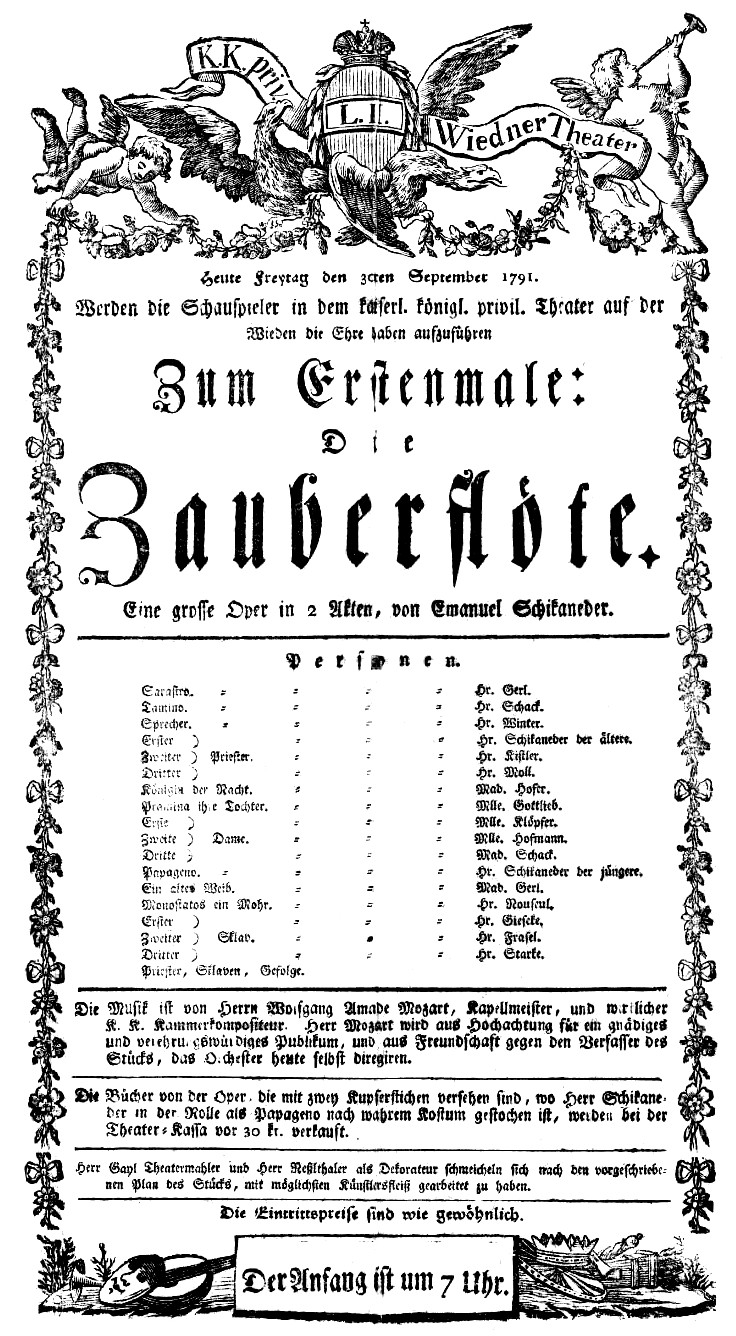
On September 30 Die Zauberflöte premiered at the Theater auf der Wieden in suburban Vienna. Schikaneder's libretto was thick with Masonic symbolism (three chords, three Ladies, three Boys, Tamino's trials). It became an instant hit with both commoners and aristocrats. Mozart conducted the last performance he attended five weeks before his death.
On December 7 he was buried outside Vienna at St. Marx cemetery in a Schachtgrab (a shaft grave for multiple bodies) — the standard Viennese commoner burial. The location was known, but unmarked. After about ten years the bones were cleared by regulation to reuse the plot. In 1855 someone tried to locate his bones; in 1859 a memorial was placed at the Zentralfriedhof. In 1902 a skull at St. Marx was identified as "possibly Mozart's" — scholars dispute it to this day.
He died at 1 AM on December 5. Constanze was too grief-stricken to handle arrangements; their friend Baron van Swieten organized the funeral. Vienna at the time favored extremely austere funerals — bodies of common Viennese were buried 5-10 to an unmarked wooden coffin, the bones cleared out after about 10 years to reuse the grave. Mozart received this standard treatment, not a special insult.
He took to bed about November 20 — body swollen, high fever, in great pain. Diagnosed at the time as "miliary fever" (modern medical historians have proposed strep, acute kidney failure, parasitic infection, mercury poisoning, Henoch-Schönlein purpura — no consensus). Even dying he dictated the Lacrimosa of the Requiem and instructed his pupil Süssmayr how to finish it.
Constanze, to collect the remaining commission from Walsegg, had to deliver a complete Requiem. She first asked Eybler, who gave up; then Mozart's pupil Süssmayr. Süssmayr finished it in February 1792, even forging Mozart's signature. Versions and authenticity have been disputed ever since — but for 200 years the Mozart Requiem heard worldwide is largely the Süssmayr completion.
Within months of Mozart's death, Vienna gossip spread: "Salieri poisoned him from envy." Salieri denied it in life; in his demented old age he was reported to have "confessed." But contemporary medical records, the actual cordial relationship (Salieri taught Mozart's son), and modern scholarship all reject the story. Pushkin wrote it as a play in 1830, and Peter Shaffer's 1979 Amadeus (adapted into the 1984 film, eight Oscars) embedded the legend in popular culture.
奧地利植物學家、礦物學家、業餘音樂學家 Ludwig von Köchel 1862 年出版 Mozart 作品總目錄、按時間順序編號 1-626。從此「K. 編號」成為國際 Mozart 作品標準引用法。最後一首是《安魂曲》K.626。
The Austrian botanist, mineralogist, and amateur musicologist Ludwig von Köchel published the first complete catalog of Mozart's works in 1862, numbering them chronologically 1-626. The "K. number" became the international standard for citing Mozart's works. The final number, K.626, is the Requiem.
Directed by Miloš Forman, screenplay by Peter Shaffer (adapted from his 1979 play). Tom Hulce played Mozart with his trademark cackling laugh; F. Murray Abraham played the envious Salieri (Best Actor Oscar). Won 8 Oscars (Best Picture, Director, Actor, Adapted Screenplay, etc.). The film projected the Salieri-poisoning myth around the world. The Mozart most people know today is the Mozart of this film.