Son of a Bonn court musician beaten awake at night by his alcoholic father. At 22 he moved to Vienna to study with Haydn. At 26 his hearing began to fail; at 32 he wrote the Heiligenstadt Testament contemplating suicide — and chose to live for his art. The Eroica was originally for Napoleon; the title page was torn off in fury when he crowned himself emperor. Totally deaf by 45, he communicated through conversation books. At the 1824 premiere of the Ninth he could not hear it; a singer turned him round to see the audience weeping and ovating. The identity of his "Immortal Beloved" is still disputed two centuries on. He died at 56 in a Vienna thunderstorm, fist raised at the sky; 30,000 came to the funeral. Two hundred years later the Ode to Joy became the anthem of Europe — "all men shall be brothers" finally realized.
📌 內容與授權:本頁事件說明文字(中英)為 Cosmic History Timeline 編輯整理。
圖片來自 Wikimedia Commons,作者與授權詳見每張圖下方連結。
延伸閱讀的 Wikipedia 與 Amazon 連結著作權歸原權利人;Amazon 連結為聯盟連結(不影響你的價格)。
📌 Sources & Credits: Event descriptions (zh / en) are editorial work by Cosmic History Timeline.
Images are sourced from Wikimedia Commons — author and license shown below each image.
Wikipedia and Amazon links belong to their respective rights holders; Amazon links are affiliate links (no extra cost to you).
Bach establishes the foundations of polyphonic music; Beethoven pioneers Romanticism — together they represent the pinnacle of Western classical music.
Son of a Bonn court musician with a violent alcoholic father. At 22 went to Vienna to study with Haydn. At 26 his hearing began to fail; at 32 he wrote the Heiligenstadt Testament contemplating suicide. But he kept composing — Eroica, Fifth, Pastoral, Moonlight, Appassionata, the Ninth. Totally deaf by 45. At the 1824 premiere of the Ninth and its Ode to Joy he could not hear the music; a singer had to turn him round to see the audience standing and weeping. Never married. Left the mysterious letter "To the Immortal Beloved." Dead at 56 in a Vienna thunderstorm, 30,000 attended the funeral.
12 月 17 日受洗於 Bonn (推算出生 12.16)。父親 Johann van Beethoven 是宮廷男高音、酗酒、家暴。聽說 Mozart 6 歲巡演成名後,把 Beethoven 當第二個 Mozart 培養——半夜把睡眠中的兒子打醒練琴、酒醉時以拳逼他練到深夜。
Baptized in Bonn on December 17 (probably born December 16). Father Johann van Beethoven was a court tenor, alcoholic, and physically abusive. Hearing of Mozart's child-prodigy fame, he tried to make young Ludwig a second Mozart — beating him awake at night to practice, drunkenly forcing him to play until dawn.
At 17 he made his first trip to Vienna to study. Legend says he played for Mozart, who remarked: "Mark this young man — he will make a noise in the world." (Scholars dispute the meeting actually happened.) After only two weeks news came that his mother Maria Magdalena was dying; he rushed back to Bonn. She died in July. He became the family's financial pillar, caring for two younger brothers his alcoholic father could not.
22 歲赴 Vienna·跟 Haydn 學At 22, Vienna for Good — Studies with Haydn
圖:Blasius Höfel / After Louis Rene Letronne · Public domain · Wikimedia CommonsImage: Blasius Höfel / After Louis Rene Letronne · Public domain · Wikimedia Commons
In November he moved to Vienna to study composition with Haydn. Haydn was gentle but they did not click — Beethoven was abrasive and took secret lessons with other teachers. In 1794 his father Johann died; with no remaining tie to Bonn, Beethoven settled in Vienna for life. The same year his first appearances as piano virtuoso in aristocratic salons stunned Vienna.
At 26 his tinnitus began. He hid it desperately at first — as a celebrated piano virtuoso, deafness would have ended his career. He tried every contemporary remedy (cold baths, tree bark, magnets, oil in the ear) — nothing worked. He wrote his friend Wegeler: "For three years my hearing has grown worse... I have to confess, I am leading a wretched life."
At 32 he retreated for six months to the village of Heiligenstadt outside Vienna. On October 6 he wrote a letter to his two brothers (never sent in his lifetime): "Art — it was that alone that held me back. Ah, it seemed impossible to me to leave the world until I had brought forth all that I felt was within me..." The document was found in a drawer after his death — one of the most anguished human documents in music history.
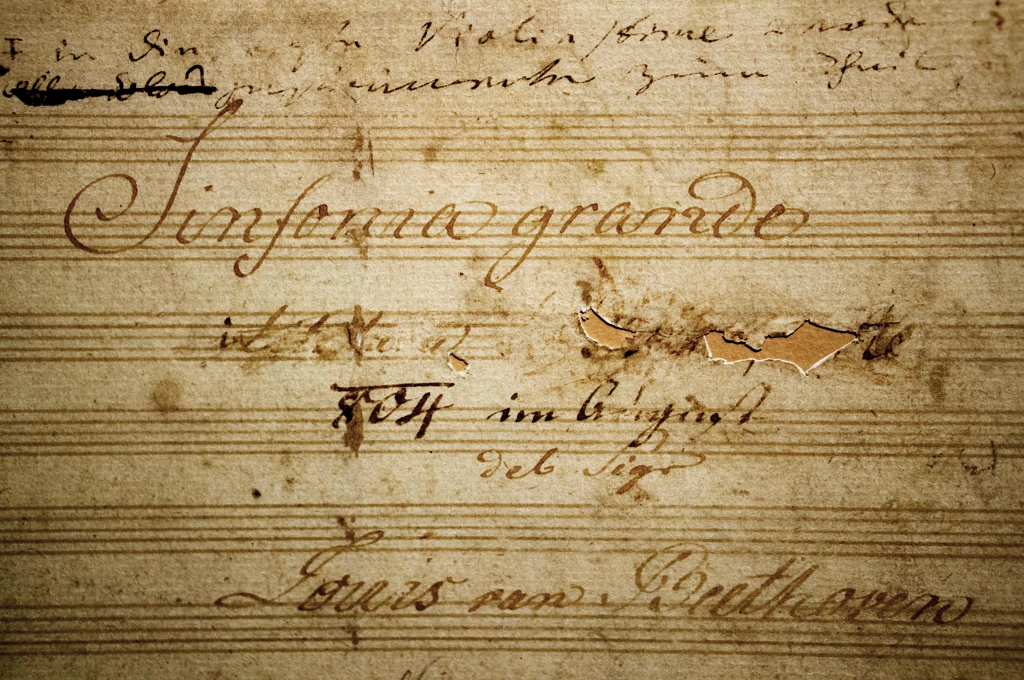
33 歲完成第三交響曲《Eroica (英雄)》。原本獻給 Napoleon——他視為自由解放者。當聽說 Napoleon 1804 自加冕為皇帝時,盛怒撕掉題詞頁、改題:「為紀念一位偉人」。這部交響曲長度與情感強度遠超 Haydn-Mozart 傳統,公認是浪漫主義音樂的開端。
At 33 he completed the Third Symphony, Eroica. Originally dedicated to Napoleon, whom he saw as a liberator. When word came that Napoleon had crowned himself Emperor in 1804, Beethoven flew into a rage, tore the title page, and rewrote the inscription: "To the memory of a great man." The symphony's scale and emotional intensity broke completely with the Haydn-Mozart tradition — the moment Romanticism in music began.
At 35 he completed his only opera, Fidelio — Leonore disguises herself as a man to rescue her imprisoned husband, on themes of freedom and marital fidelity. The November premiere coincided with French occupation of Vienna; the aristocrats had fled, and the audience was mostly French officers. It flopped. A revised version in 1814 finally succeeded.
12 月 22 日 Theater an der Wien 首演第五交響曲——開頭「短-短-短-長」四音動機是西方音樂最知名片段。學徒 Schindler 後來宣稱 Beethoven 自言「這是命運敲門」(學界懷疑為杜撰)。同一場音樂會還首演了第六《田園》、第四鋼琴協奏曲、《合唱幻想曲》——4 小時極寒長音樂會、觀眾凍著聽到底。
On December 22 at the Theater an der Wien, the Fifth Symphony premiered — its opening short-short-short-long four-note motif is the most famous fragment in Western music. Schindler later claimed Beethoven told him: "Thus Fate knocks at the door" (scholars suspect Schindler invented this). The same concert also premiered the Sixth (Pastoral), the Fourth Piano Concerto, and the Choral Fantasy — a four-hour concert in a freezing hall, the audience shivering through.
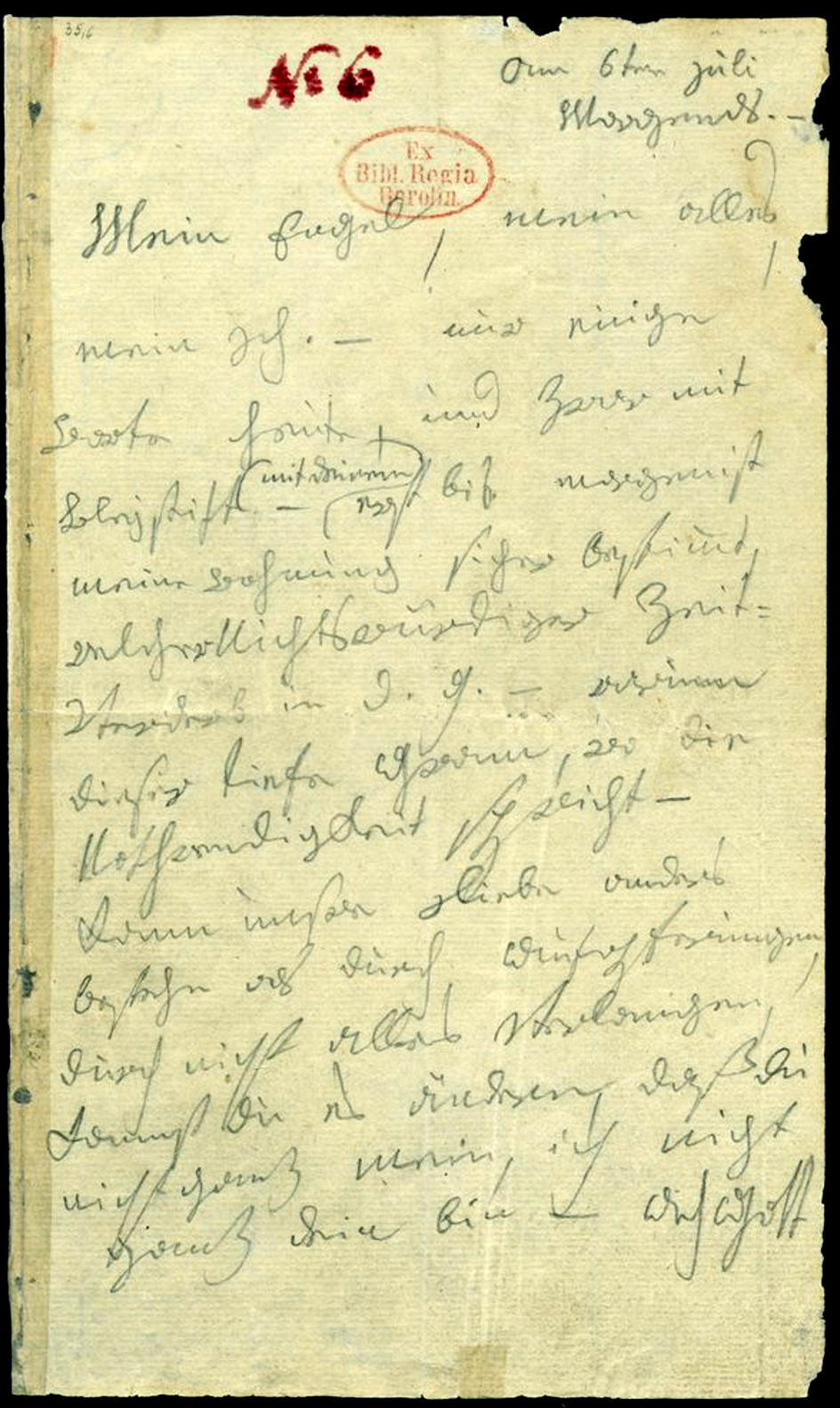
7 月 6-7 日從溫泉地 Teplitz 寫一封 10 頁長熱情情書給「我的天使、我的一切、我自己」(My angel, my all, my very self)。沒寄、沒收信人姓名、沒年份、Beethoven 死後在抽屜被發現。「永遠愛人」(Immortal Beloved) 身分 200 年來爭議——可能是 Antonie Brentano、Josephine Brunsvik、Therese Malfatti 或 Bettina Brentano。1994 同名電影 Gary Oldman 主演。
On July 6-7 from the spa town of Teplitz he wrote a passionate ten-page love letter addressed to "My angel, my all, my very self." Never sent. No name, no year on it. Found in a drawer after his death. The identity of the "Immortal Beloved" has been debated for 200 years — possibly Antonie Brentano, Josephine Brunsvik, Therese Malfatti, or Bettina Brentano. A 1994 film of the same name starred Gary Oldman.
After his last public piano performance in 1814 (Seventh Symphony) deafness worsened — strings broke under his pounding, his playing fell out of sync with the orchestra. He retired from performance forever. From then on he communicated through "conversation books" (Konversationshefte) — friends wrote their questions, he answered aloud. 140 of these books survive — the most important source for his daily life.
弟弟 Caspar Carl 1815 死,Beethoven 與弟媳 Johanna (他蔑稱為「夜晚皇后」) 為侄 Karl (9 歲) 監護權打 5 年官司。法院多次易主、終於 1820 由 Beethoven 取得獨佔監護權。但他過度嚴厲、Karl 18 歲 1826 自殺未遂——舉槍打自己頭僅擦傷。Karl 戰場退出生活、Beethoven 心碎。
His brother Caspar Carl died in 1815. Beethoven fought his sister-in-law Johanna (whom he called the "Queen of the Night") for custody of nephew Karl (age 9), through five years of court battles. Custody flipped repeatedly until Beethoven won sole guardianship in 1820. But he was too harsh; Karl at 18 attempted suicide in 1826 — shot himself in the head, the bullet only grazing him. Karl moved out, broken. Beethoven was shattered.
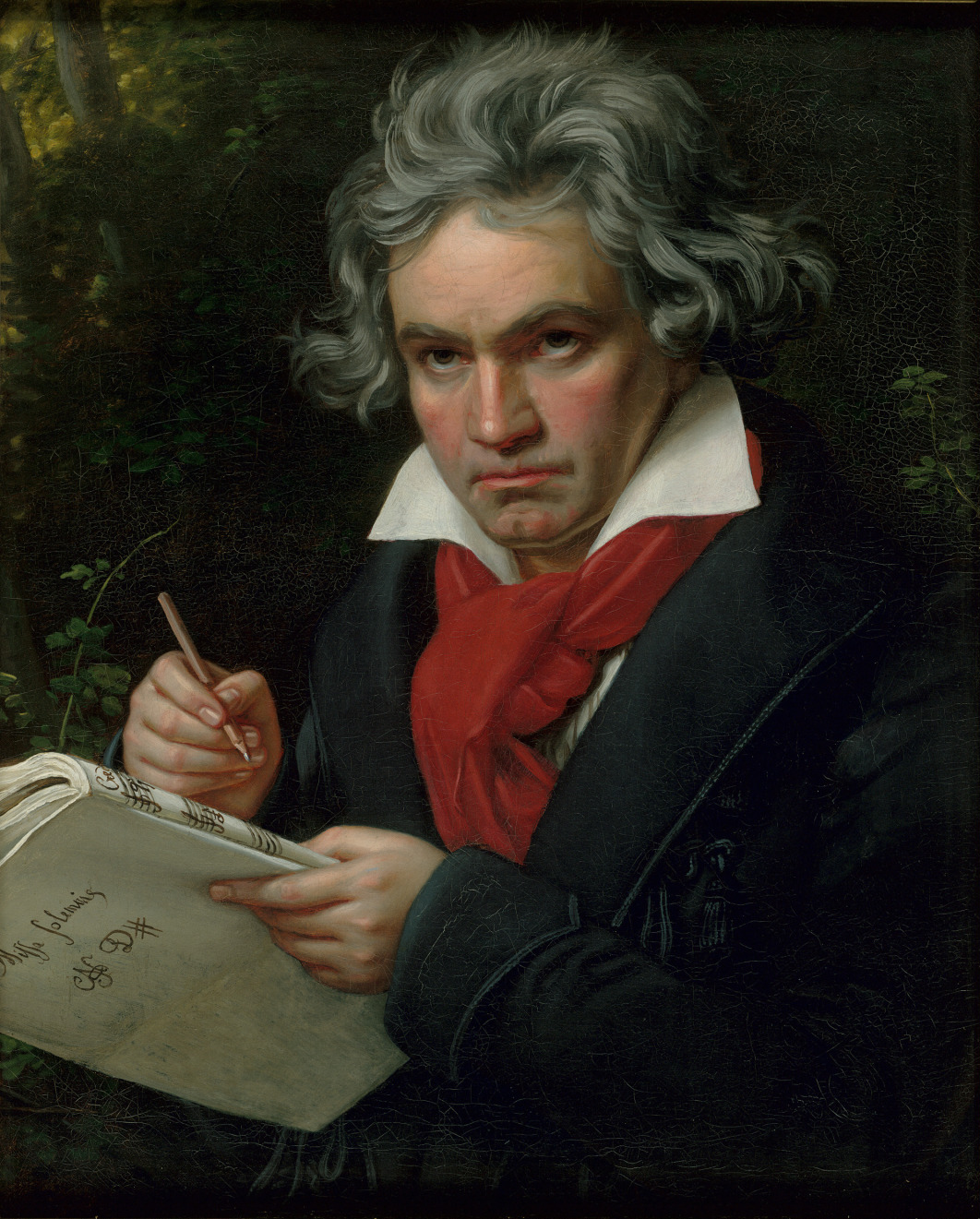
耗時 4 年完成《莊嚴彌撒 Missa Solemnis》(D 大調)。原本獻給弟子 Archduke Rudolph 1820 任樞機主教時,但晚 3 年才完工。Beethoven 自認是「我最大的成就」、超越《第九》。在樂譜首頁寫:「來自心、走進心」(Vom Herzen — Möge es wieder zu Herzen gehen)。
After four years he completed the Missa Solemnis in D Major. Originally intended for the elevation of his pupil Archduke Rudolph as cardinal in 1820 — three years late. Beethoven considered it "my greatest work," greater than the Ninth. At the head of the score he wrote: "From the heart — may it return to the heart" (Vom Herzen — Möge es wieder zu Herzen gehen).
On May 7 the Ninth Symphony premiered in Vienna, with Schiller's "Ode to Joy" sung in the finale. Beethoven stood by the conductor turning pages and beating time (the actual conducting was done by Umlauf). At the end the orchestra and audience rose to ovation five times, but Beethoven still stood facing the score — the alto Caroline Unger had to turn him around to see the audience weeping and applauding. Police reportedly intervened four times (only royalty was allowed three rounds of applause).
In the last 18 months of his life he wrote five late string quartets — Op.127, 130, 131, 132, 135 — plus the Grosse Fuge Op.133. Contemporary players refused them as too hard and bizarre; critics called them "the work of a madman." Today they are considered the most profound and abstract music ever written — direct influence on Stravinsky, Schoenberg, and Bartók. Beethoven said he had written them "for a later age."
3 月 26 日 Vienna 暴風雨中死於 56 歲 (肝硬化或其他)。傳說最後時刻、暴雷一聲、他突然睜眼、握拳舉向天空——然後手垂、氣絕。臨終前 2 個月他才被告知 Karl 自殺未遂、心力交瘁。出版商 Schott 來信問新作 — Beethoven 答:「Pity, pity, too late!」(可惜、可惜、太遲了!)。
On March 26 in a Vienna thunderstorm he died at 56 (cirrhosis or related). Legend says at the last moment, a thunderclap, he suddenly opened his eyes and raised his fist to the sky — then dropped it, and was gone. Two months earlier he had been told of nephew Karl's suicide attempt — the blow exhausted him. His publisher Schott had written for new work; Beethoven replied: "Pity, pity, too late!"
On March 29 the funeral filled the streets — Vienna's schools closed, 30,000 attended (Vienna's population was 300,000, so 10% came). Schubert was one of 36 torchbearers escorting the coffin. Schubert died a year later and by his own wish was buried beside Beethoven. The funeral oration, written by the poet Grillparzer, said: "He chose the hardest way in this world; he left the most complete legacy."
1972 歐洲委員會選《第九交響曲》末樂章《歡樂頌》主題為「歐洲之歌」。1985 歐盟正式採為盟歌——無歌詞 (避免語言政治、Schiller 詩仍可用德文唱)。今日所有 EU 官方場合、奧運頒獎、柏林圍牆倒塌音樂會均演奏。Beethoven 「四海之內皆兄弟」的理想在 200 年後成為歐洲團結的聲音象徵。
In 1972 the Council of Europe chose the Ode to Joy theme from the Ninth's finale as the "Anthem of Europe." In 1985 the EU adopted it officially as its anthem — without words (to avoid language politics; Schiller's German poem can still be sung). Today it plays at all official EU functions, Olympic medal ceremonies, and the concert at the fall of the Berlin Wall. Beethoven's "all men shall be brothers" became, 200 years later, the sound of European unity.
葬禮後弟子 Ferdinand Hiller 剪了一綹頭髮存留 200 年、輾轉到美國 Beethoven Center。1994 拍賣 7000 美元、2000 年代化學分析發現鉛含量是正常的 100 倍——可能是當時治胃病用的鉛酒、或多瑙河魚、或飲多瑙河水所致。鉛中毒解釋了他的耳聾、肝硬化、暴躁性格。
After the funeral his pupil Ferdinand Hiller cut a lock of hair that survived 200 years, eventually reaching the Beethoven Center in California. Sold at auction in 1994 for $7,000, in the 2000s chemical analysis revealed lead levels 100 times normal — perhaps from lead-laced wine for stomach ailments, or contaminated Danube fish, or the river water itself. Lead poisoning explains his deafness, cirrhosis, and famous irascibility.