📌 內容與授權:本頁事件說明文字(中英)為 Cosmic History Timeline 編輯整理。
圖片來自 Wikimedia Commons,作者與授權詳見每張圖下方連結。
延伸閱讀的 Wikipedia 與 Amazon 連結著作權歸原權利人;Amazon 連結為聯盟連結(不影響你的價格)。
📌 Sources & Credits: Event descriptions (zh / en) are editorial work by Cosmic History Timeline.
Images are sourced from Wikimedia Commons — author and license shown below each image.
Wikipedia and Amazon links belong to their respective rights holders; Amazon links are affiliate links (no extra cost to you).
In March, young Kaiser Wilhelm II forced the 75-year-old Bismarck to resign. Germany abandoned Bismarck's Reinsurance Treaty system for an aggressive 'Weltpolitik' — a long fuse toward World War I.
From June to August, dissatisfied with its share, Bulgaria attacked Serbia and Greece; the Ottomans and Romania also joined against Bulgaria. Bulgaria lost badly, and Balkan tensions fully boiled — setting the stage for Sarajevo.
On June 28, Archduke Franz Ferdinand of Austria-Hungary and his wife were assassinated in Sarajevo by Serbian nationalist Princip — triggering the July Crisis and World War I.
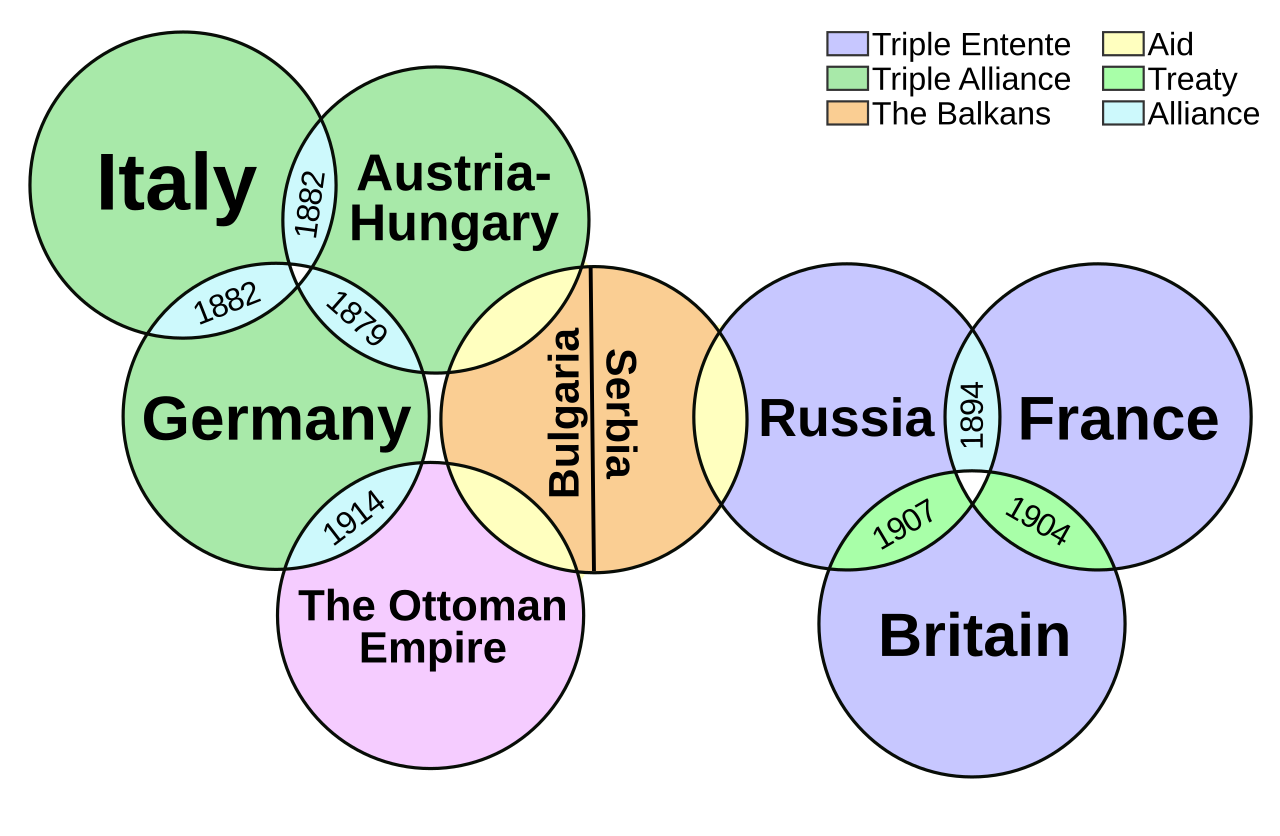
After Austria-Hungary's ultimatum to Serbia in July–August, chain mobilizations followed: Russia mobilized, Germany declared war on Russia and France, Britain joined after Belgium's neutrality was violated. Europe slid into world war.
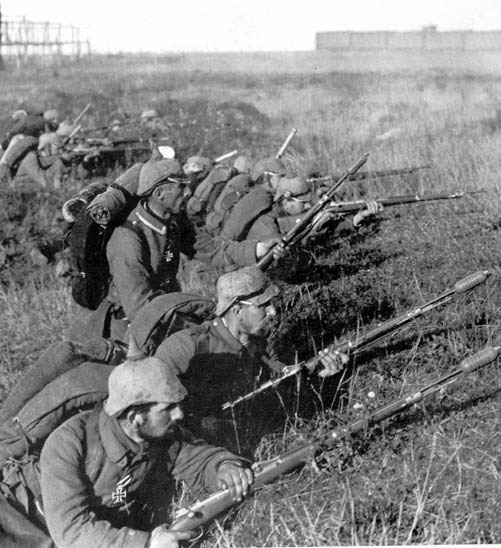
On August 1–4, Germany declared war on Russia and France and invaded neutral Belgium to execute the Schlieffen Plan. Britain entered the war over Belgium's violated neutrality.
On September 6–12, French and British forces counterattacked the Germans on the Marne near Paris, halting the Schlieffen Plan. Paris taxis ferrying troops to the front became legend; trench warfare took hold.
In August, Hindenburg and Ludendorff encircled the Russian Second Army in East Prussia, capturing 90,000 and driving General Samsonov to suicide. The Russian invasion of Germany failed and the Eastern Front legend of the German army began.
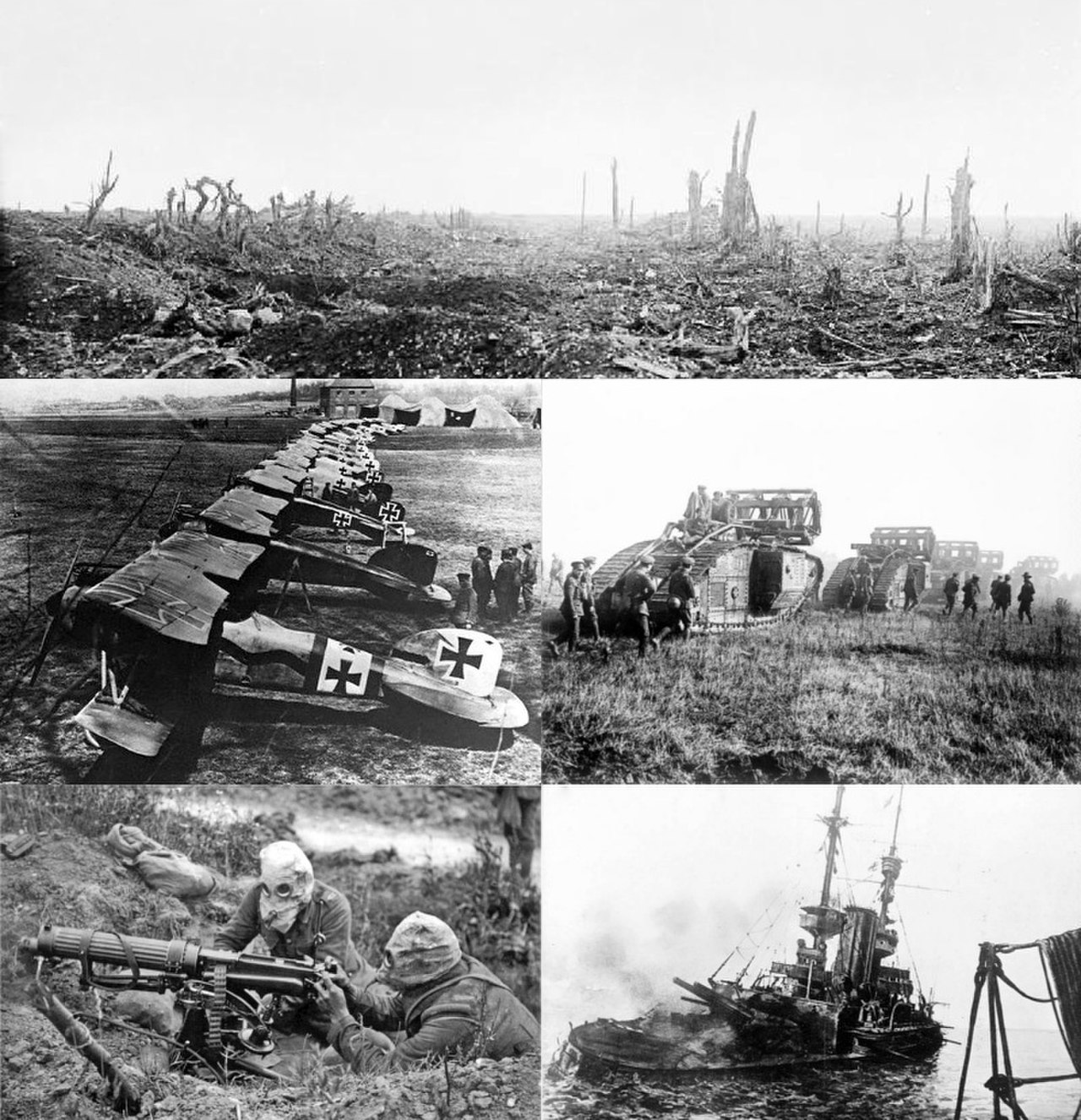
From October to November, British, French, and Belgian forces halted the German 'Race to the Sea' at Ypres. Mobile warfare ended and both sides dug in — setting the four-year stalemate of the Western Front.
On April 22, Germany launched the first large-scale chlorine gas attack on the Western Front, killing a thousand Allied soldiers and bringing chemical weapons into modern warfare.
In May, German–Austrian forces shattered Russian lines in southern Poland, triggering the 'Great Retreat' out of Poland, Lithuania, and Galicia. Russia lost a million men, weakening the empire.
The Ottoman government carried out mass deportations and massacres of its Armenian population on security pretexts. An estimated 1–1.5 million died (1915–1923) — the 20th century's first large-scale systematic genocide.
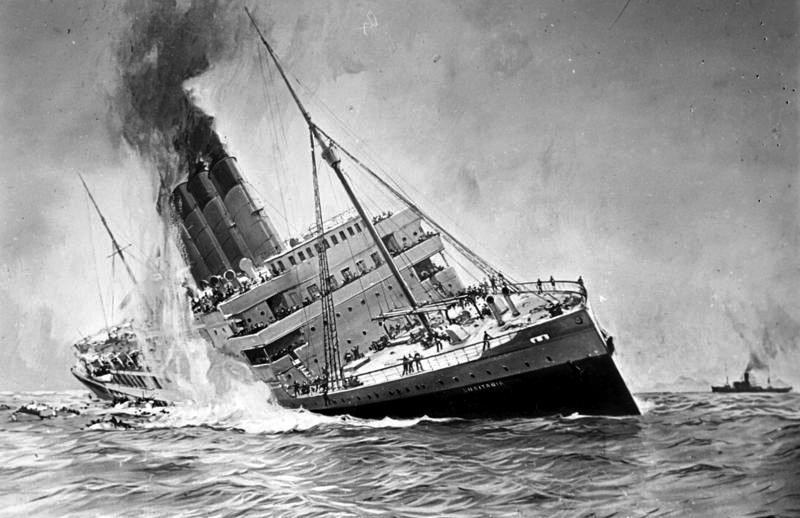
5 月 7 日英國客輪盧西塔尼亞號遭德國 U 艇擊沉,1,198 人罹難含 128 名美國人,衝擊美國輿論、埋下日後參戰伏筆。
On May 7, a German U-boat sank the British liner Lusitania. 1,198 died, including 128 Americans — shocking U.S. public opinion and sowing seeds for later intervention.
On April 24, the CUP government arrested Armenian intellectual elite in Constantinople (now Armenian Remembrance Day). Armenian civilians of Anatolia were deported to the Syrian desert via death marches, massacres, starvation, and disease — approximately 1.5 million died (half the entire people). The 20th century's first state-planned genocide, inspiring the word 'genocide.' Turkey still officially denies it.
In April, Italy abandoned the Triple Alliance and signed the Treaty of London with the Allies, promised South Tyrol, Trieste, and other territories. On May 23, Italy declared war on Austria-Hungary.
2-12 月德軍攻擊凡爾登要塞欲「放血法國」,法軍以「他們不會通過」(Ils ne passeront pas)口號死守十個月。雙方傷亡共 70 萬人,是法國國族記憶頂峰。
From February to December, German forces attacked Verdun to 'bleed France white.' The French held on for ten months under the rallying cry 'Ils ne passeront pas.' Casualties totaled 700,000 — the apex of French national memory.
In April, Irish Republicans rose in Dublin to declare independence while British forces were on the Western Front. The British crushed the rising and executed 15 leaders, galvanizing the Irish independence movement.
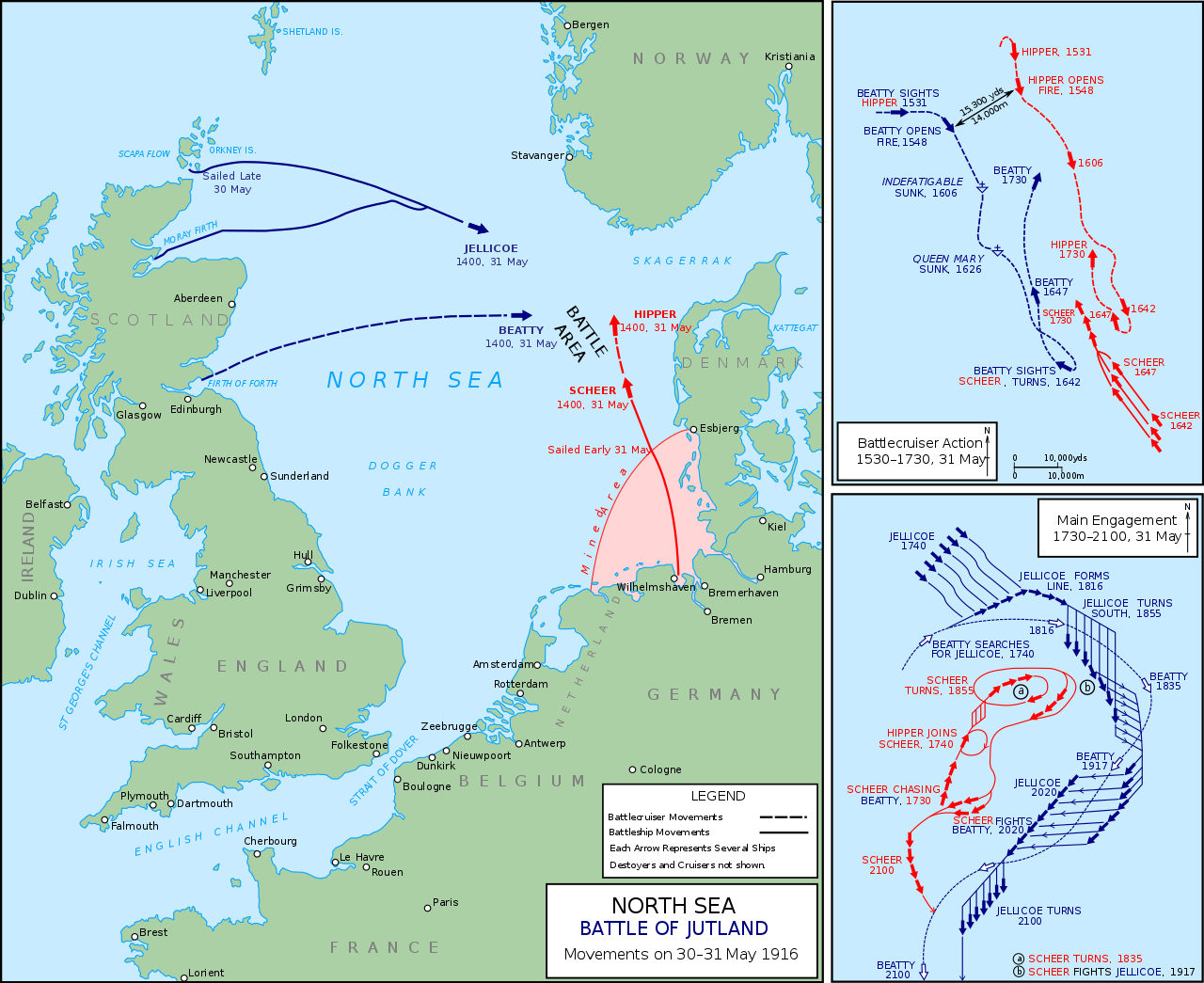
5 月 31 日-6 月 1 日英德主力艦隊在北海日德蘭海域決戰,雙方均聲稱勝利。此後德國公海艦隊蝸居港內,轉而仰賴 U 艇破交戰。
On May 31–June 1, the British and German main fleets clashed in the North Sea off Jutland. Both claimed victory; afterward the German High Seas Fleet stayed in port, and Germany pivoted to unrestricted U-boat warfare.
圖:штабс-капитан Сергей Александрович Корсаков · Public domain · Wikimedia CommonsImage: штабс-капитан Сергей Александрович Корсаков · Public domain · Wikimedia Commons
From June to September, Russian general Brusilov's novel infiltration tactics devastated Austria-Hungary. Russia's greatest victory was also a fatal blow to the Habsburgs — though the heavy cost helped accelerate the Revolution.
In June, Sharif Hussein of Mecca rose against the Ottomans with British backing. British liaison T.E. Lawrence led Arab irregulars in guerrilla warfare, culminating in the capture of Damascus in 1918.
圖:SVG version, and changes: Grandiose
Original map:Worldwari map13 largerview.jpg, · Public domain · Wikimedia CommonsImage: SVG version, and changes: Grandiose
Original map:Worldwari map13 largerview.jpg, · Public domain · Wikimedia Commons
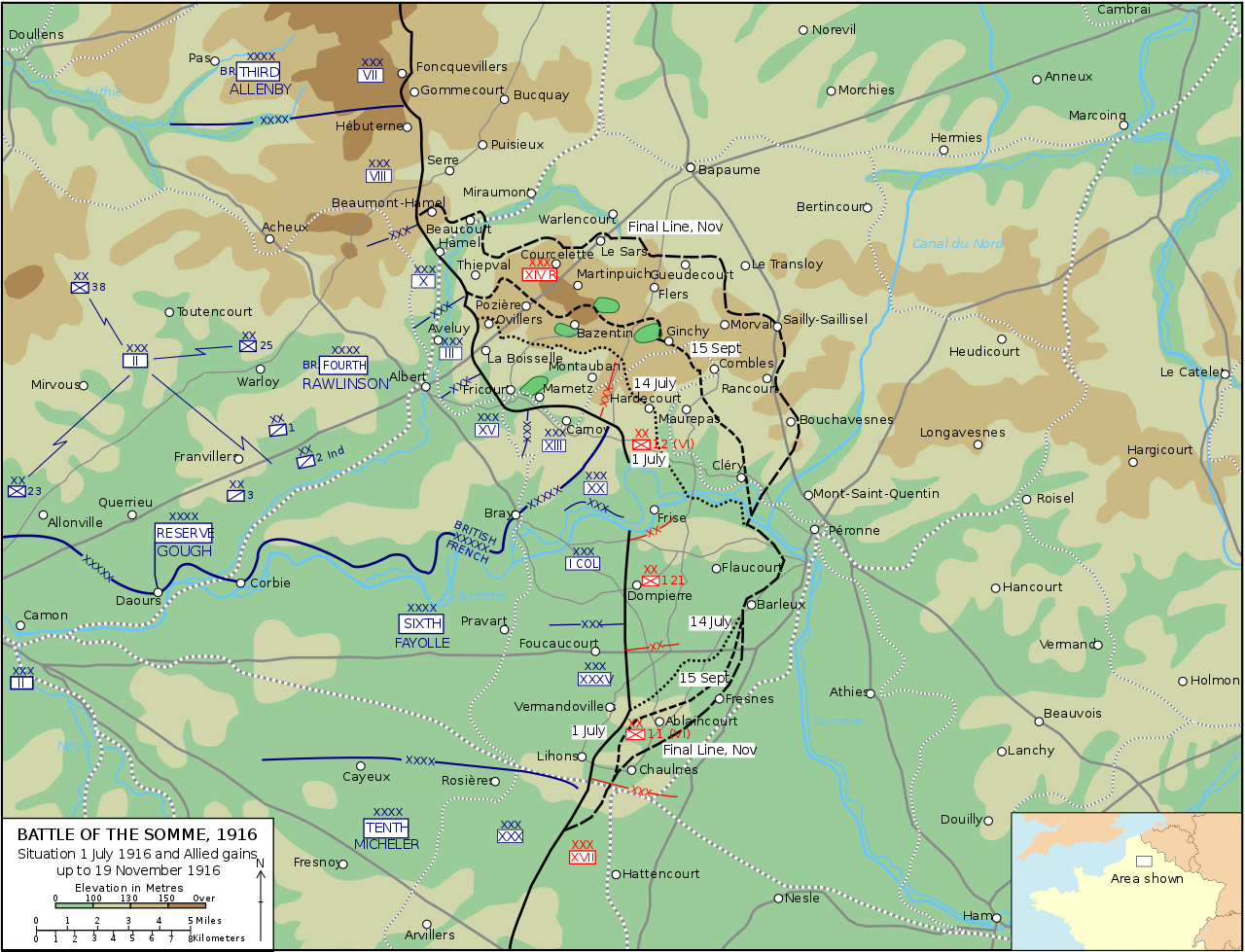
From July to November, Anglo-French forces attacked along the Somme. On the first day (July 1), Britain suffered 57,000 casualties — the bloodiest single day in British military history. Tanks were used in combat for the first time.
From 1915 to 1917, Italy launched 12 major offensives against Austria-Hungary along the Isonzo River — a mountain version of Western Front trench warfare. Over a million casualties for marginal gains.
圖:Unknown authorUnknown author or not provided · Public domain · Wikimedia CommonsImage: Unknown authorUnknown author or not provided · Public domain · Wikimedia Commons
In January, German Foreign Minister Zimmermann cabled Mexico proposing an alliance — if Germany and the U.S. went to war, Mexico would attack and reclaim Texas et al. British decryption and publication enraged American opinion.
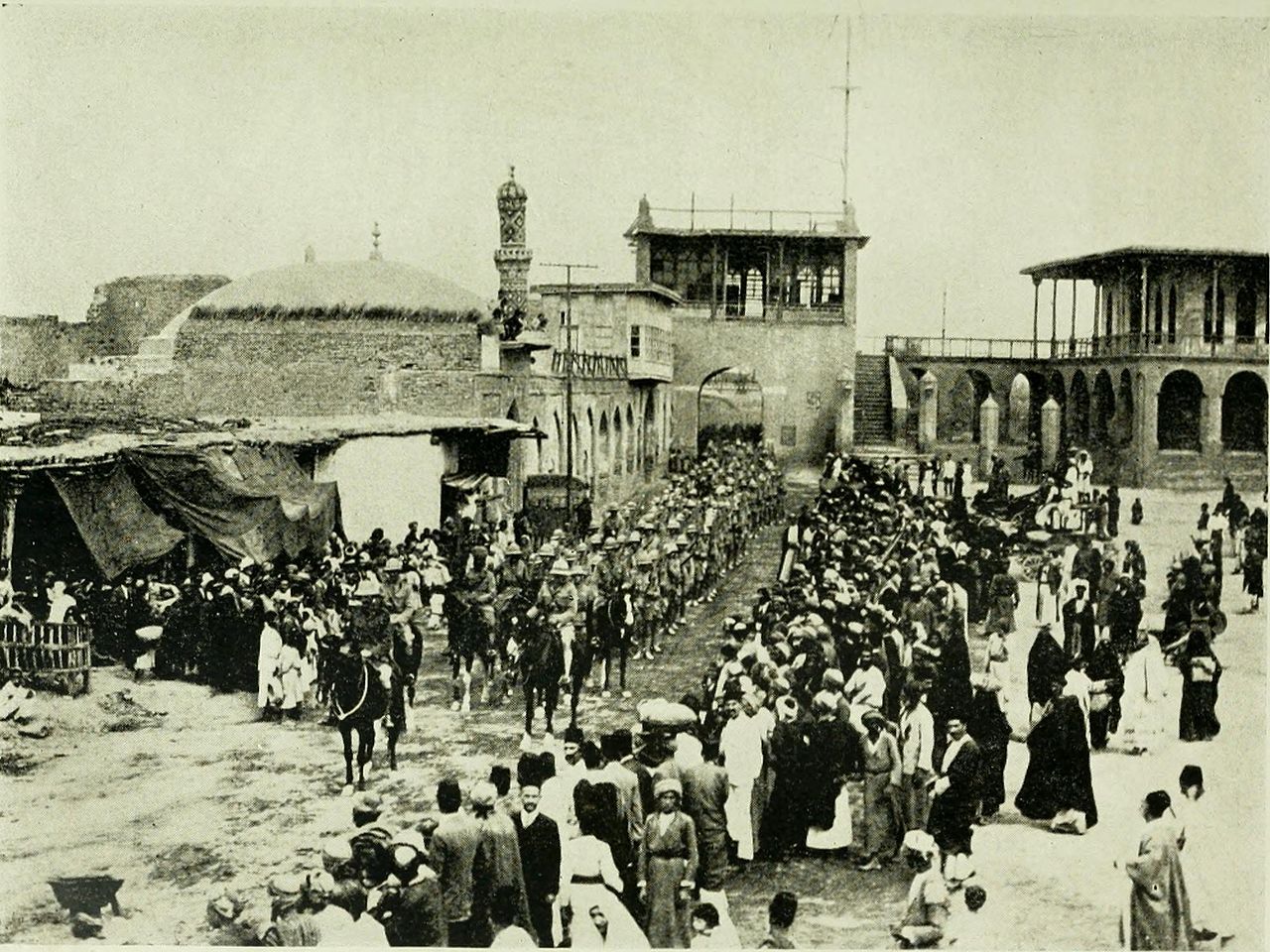
In March, Anglo-Indian forces captured Baghdad, avenging the disastrous siege of Kut the previous year. British control of Mesopotamia set the stage for the postwar Mandate of Iraq.
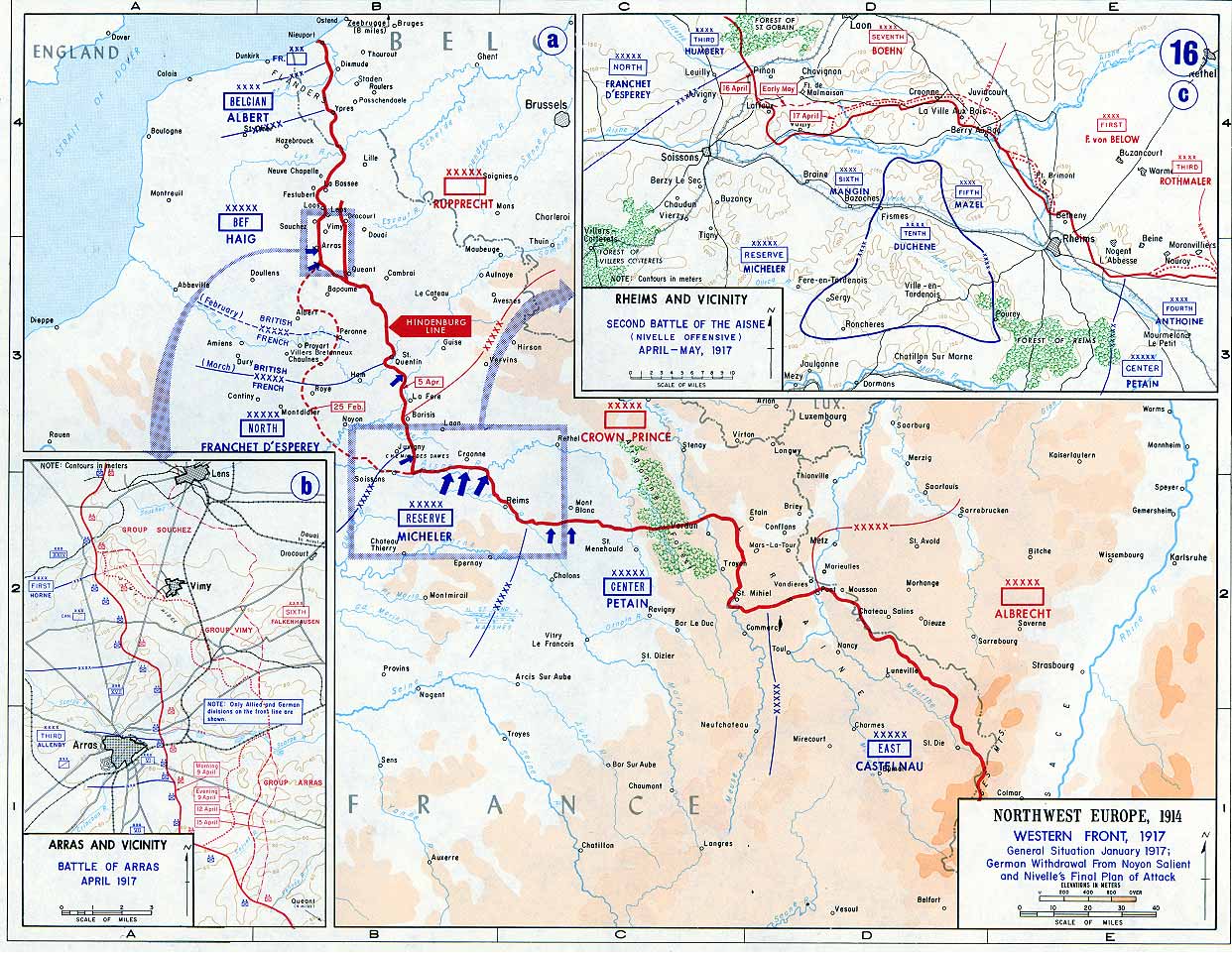
尼維勒攻勢·法軍兵變Nivelle Offensive & French Army Mutinies
圖:United States Military Academy’s Department of History[1] · Public domain · Wikimedia CommonsImage: United States Military Academy’s Department of History[1] · Public domain · Wikimedia Commons
In April, French commander Nivelle's grand offensive failed disastrously; over 40 divisions mutinied, refusing to attack. Pétain restored morale but the French army stayed on the defensive thereafter.
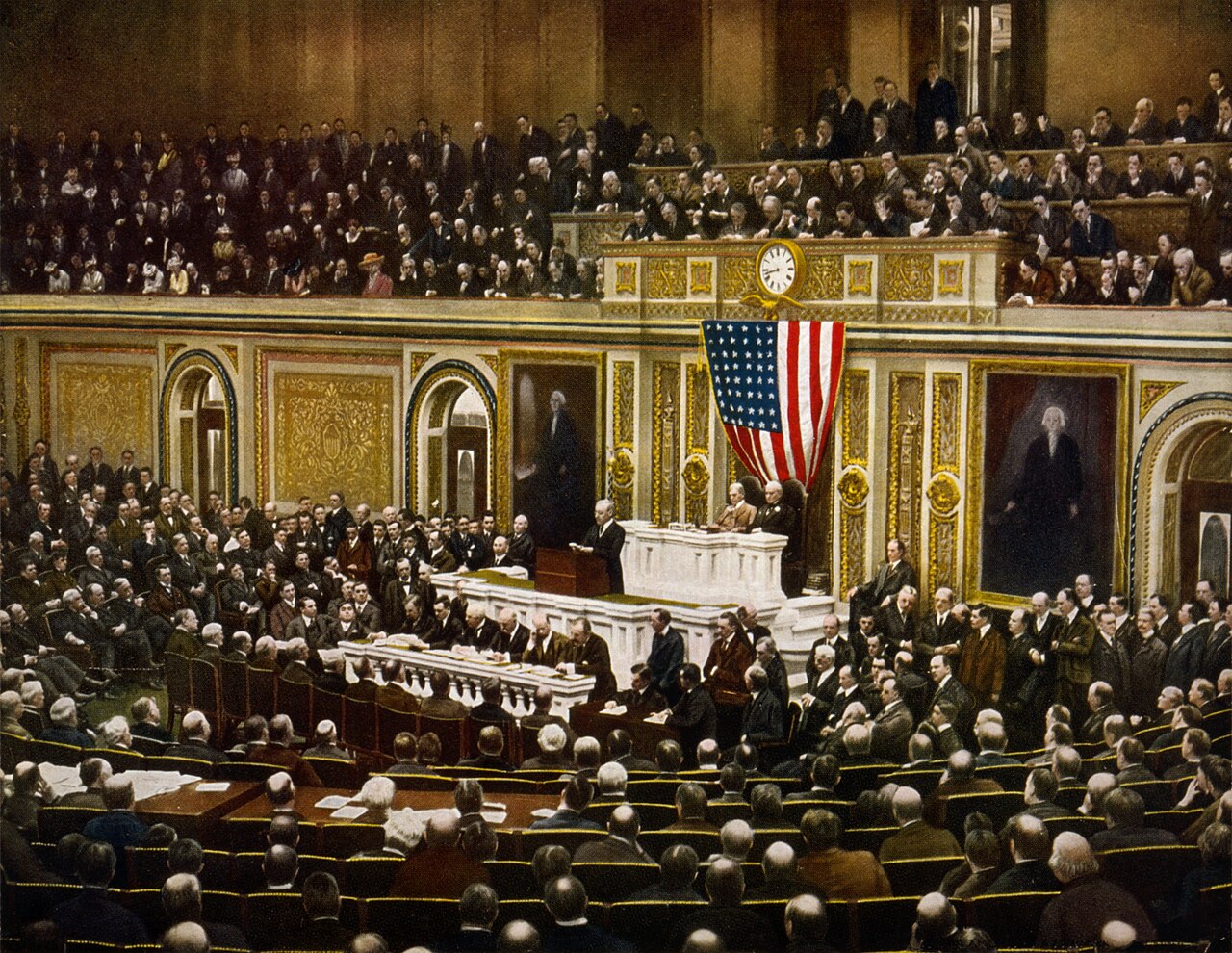
On April 6, the U.S. declared war on Germany over unrestricted submarine warfare and the Zimmermann Telegram, ending isolationism. American Expeditionary Forces on the Western Front in 1918 tipped the balance for Allied victory.
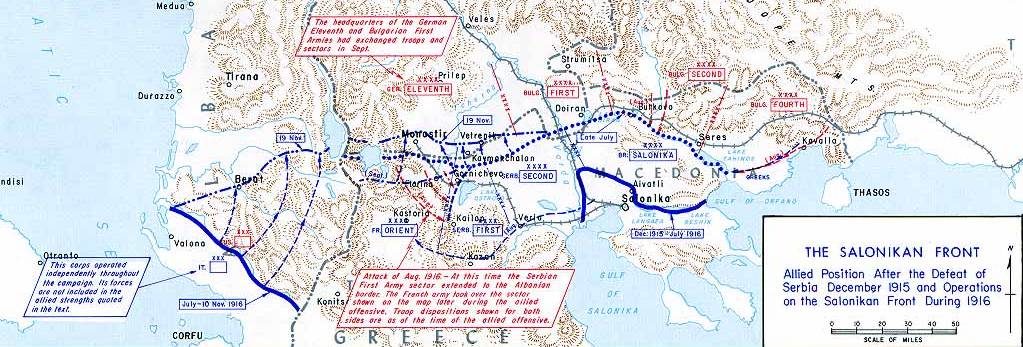
In June, under Venizelos, Greece declared war on the Central Powers and joined the Balkan Front. In 1918, Greek forces helped defeat Bulgaria on the Macedonian Front.
From July to November, a British-led offensive ground through a Belgian quagmire for 100 days. Each side lost over 200,000 men for just 8 km of gain — the emblem of trench warfare's futility.
In November (October O.S.), Lenin's Bolsheviks overthrew the Provisional Government and established the world's first socialist state. Russia withdrew from WWI, opening the 20th-century communist experiment.
In October–November, German–Austrian forces broke Italian lines using new infiltration tactics, driving them back 150 km to the Piave. 300,000 Italians were captured — the setting of Hemingway's 'A Farewell to Arms.'
In February the Representation of the People Act granted the vote to property-owning women over 30 (8.4 million) and all men over 21 (12.9 million). After militant suffragette campaigning by the Pankhursts' WSPU and women's WW1 contributions, full equality came in 1928.
On January 8, President Wilson outlined Fourteen Points in Congress, including self-determination, open diplomacy, and an international organization — the ideological blueprint for the postwar order.
On March 3, Soviet Russia signed a peace with Germany and Austria-Hungary, ceding vast territory (Ukraine, Poland, Finland, the Baltics) to exit WWI. This freed German troops for the Spring Offensive in the West.
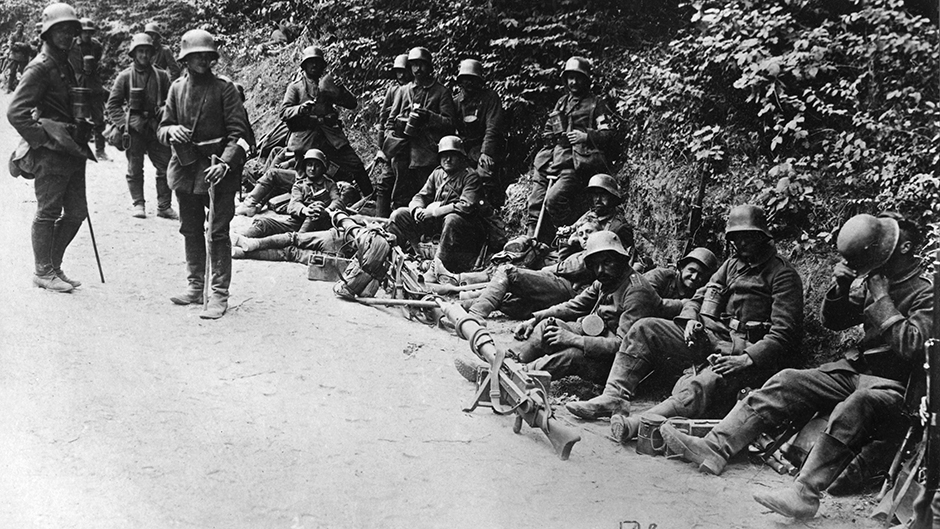
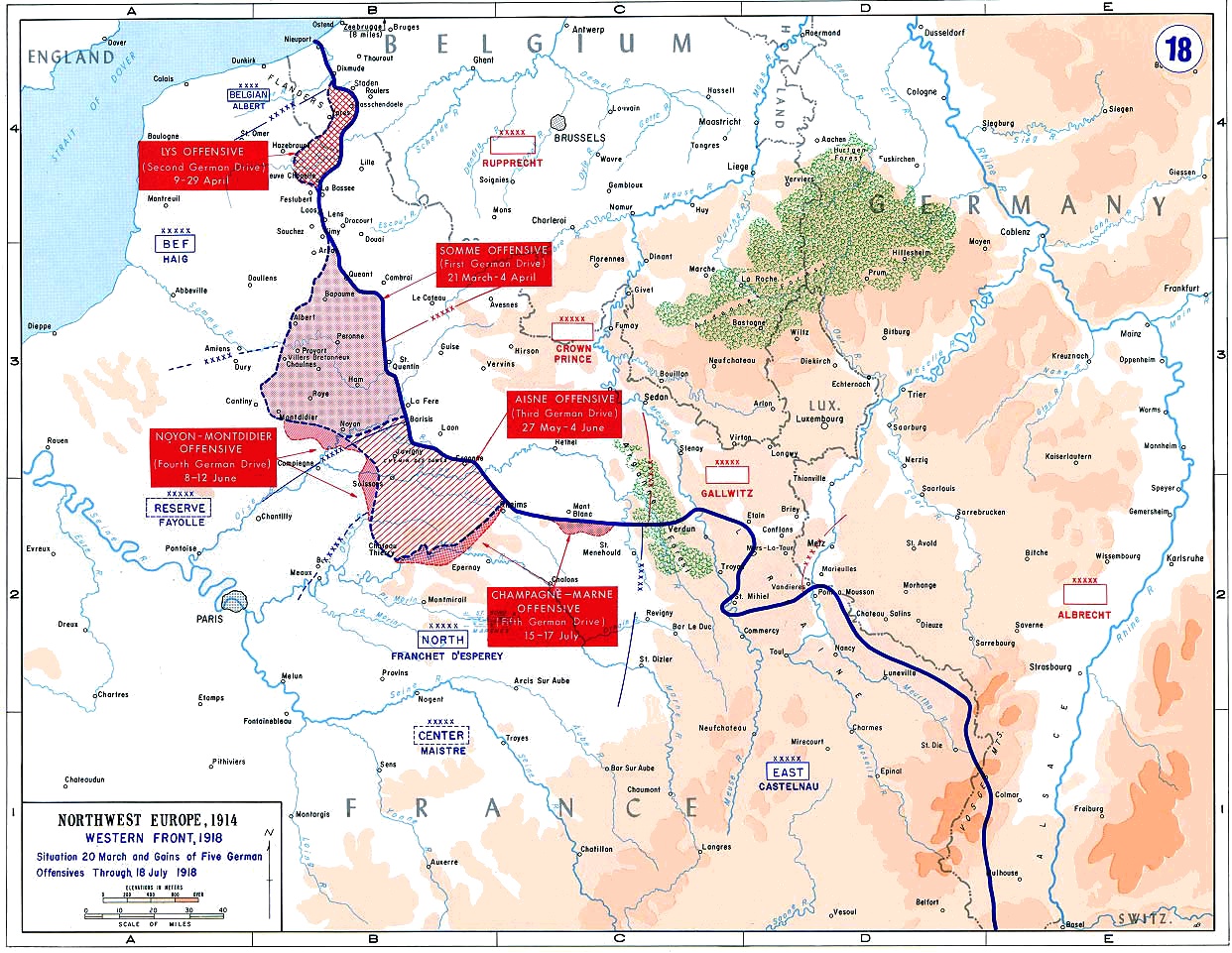
From March to July, Germany gambled everything with troops transferred from the East, advancing 100 km toward Paris. Allied defense and fresh U.S. forces exhausted the Germans, paving the way for the Hundred Days Offensive.
Beginning August 8 at Amiens (Ludendorff's 'black day of the German army'), Allied forces broke the Hindenburg Line in 100 days, forcing Germany to seek peace.
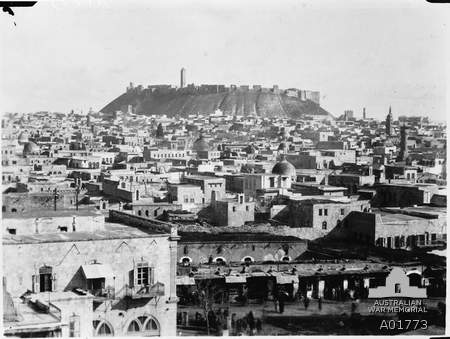
In October, British and Arab forces captured Aleppo. The Ottoman position in the Middle East collapsed, and three weeks later the Armistice of Mudros was signed.
圖:Department of Defense. Department of the Army. Office of the Chief Signal Office · Public domain · Wikimedia CommonsImage: Department of Defense. Department of the Army. Office of the Chief Signal Office · Public domain · Wikimedia Commons
From September 26 to November 11, the largest U.S. battle of the Hundred Days Offensive. Pershing commanded 1.2 million Americans against the German right flank. U.S. deaths reached 26,000 — one of the bloodiest battles in American history.
From October 24 to November 3, Italy's final offensive routed the Austro-Hungarian army. The Armistice of Villa Giusti was signed on November 3, formally dissolving Austria-Hungary — avenging Caporetto.
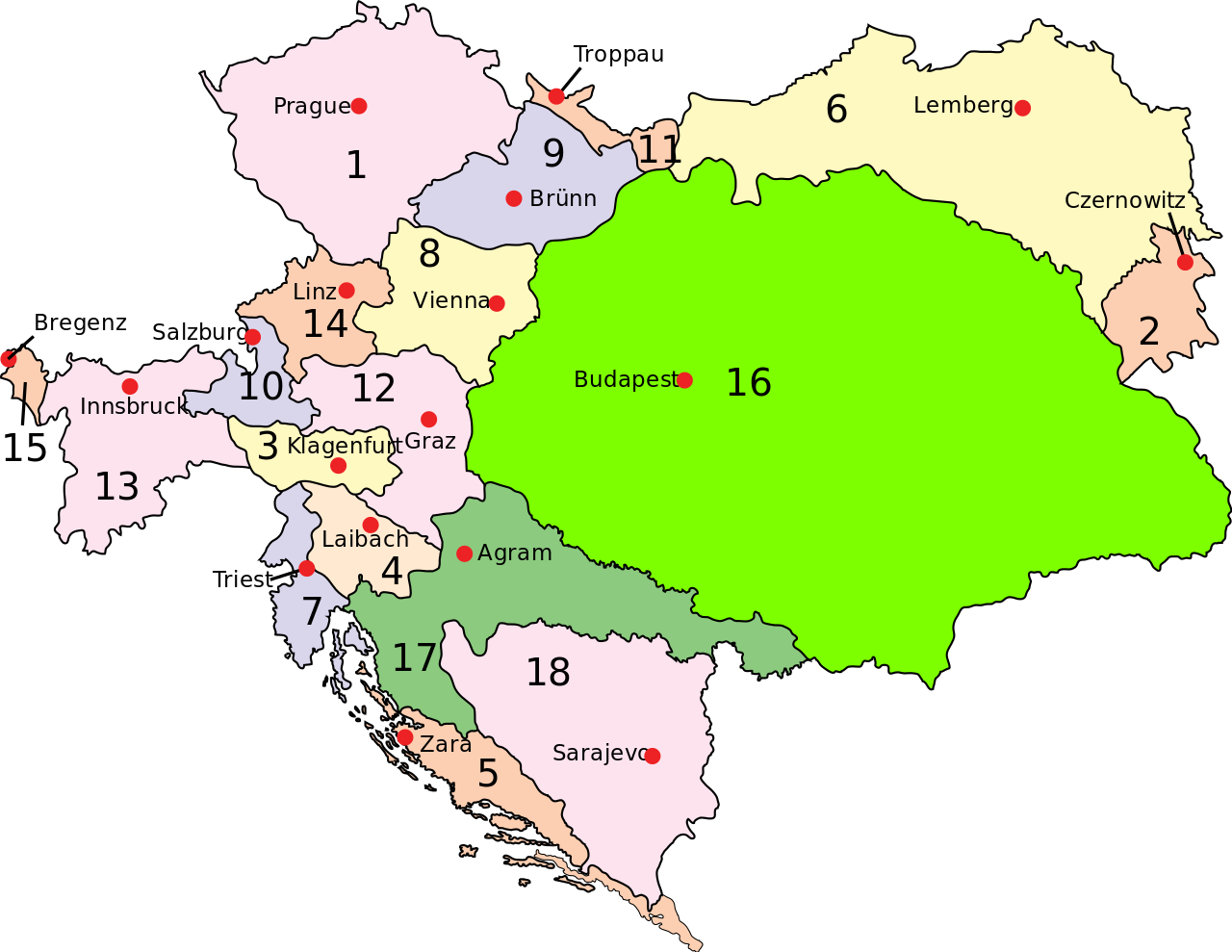
In October–November, the nationalities of Austria-Hungary declared independence: Czechoslovakia, Yugoslavia, Hungary, Austria. The 400-year Habsburg Empire dissolved.
圖:Unknown authorUnknown author or not provided · Public domain · Wikimedia CommonsImage: Unknown authorUnknown author or not provided · Public domain · Wikimedia Commons
11 月初基爾水兵拒絕出擊引爆全德革命,德皇威廉二世退位流亡荷蘭,德意志帝國終結,威瑪共和成立。
In early November, the Kiel sailors' refusal to sortie sparked a nationwide revolution. Kaiser Wilhelm II abdicated and fled to the Netherlands; the German Empire fell and the Weimar Republic was born.
圖:The postcard was published by Aspiotis in c. 1918. · Public domain · Wikimedia CommonsImage: The postcard was published by Aspiotis in c. 1918. · Public domain · Wikimedia Commons
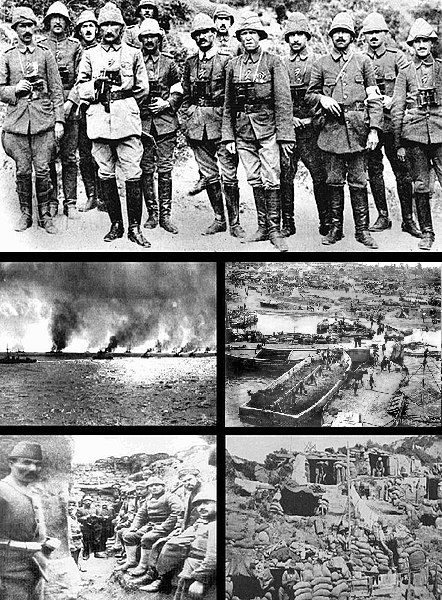
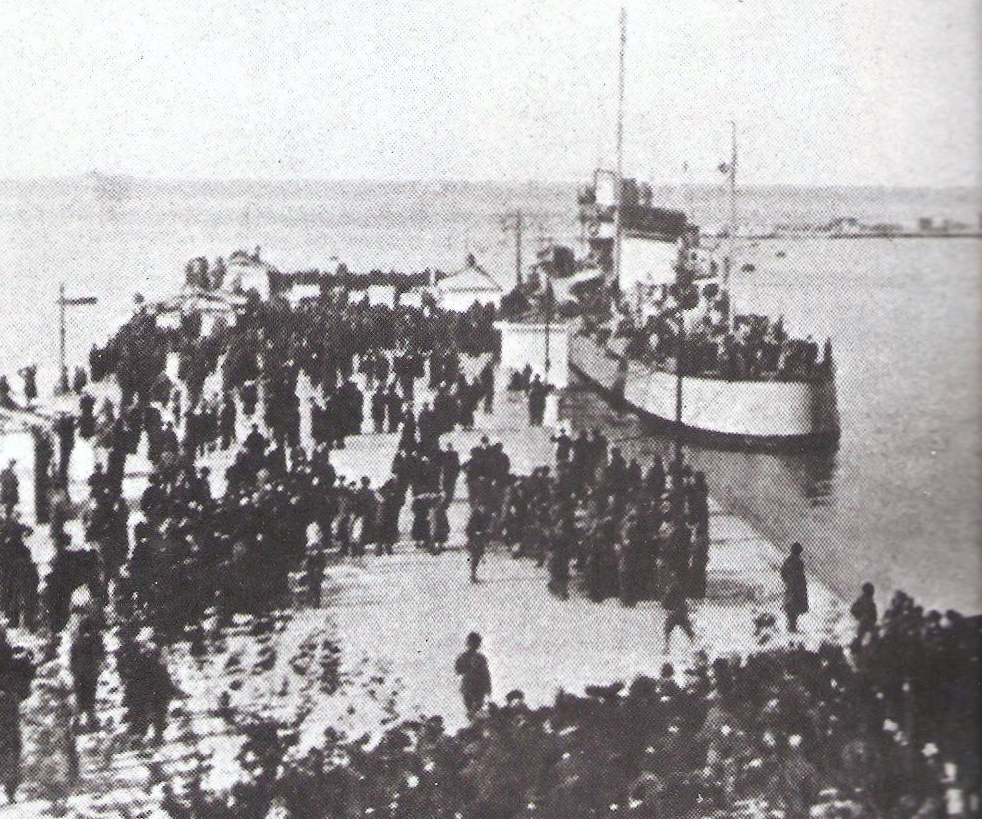
On October 30, the Ottoman Empire signed an armistice with Britain at Mudros (Aegean), opening the straits and disarming. Postwar occupation led to the Turkish War of Independence.
圖:Stanfords Geographical Establishment London · Public domain · Wikimedia CommonsImage: Stanfords Geographical Establishment London · Public domain · Wikimedia Commons
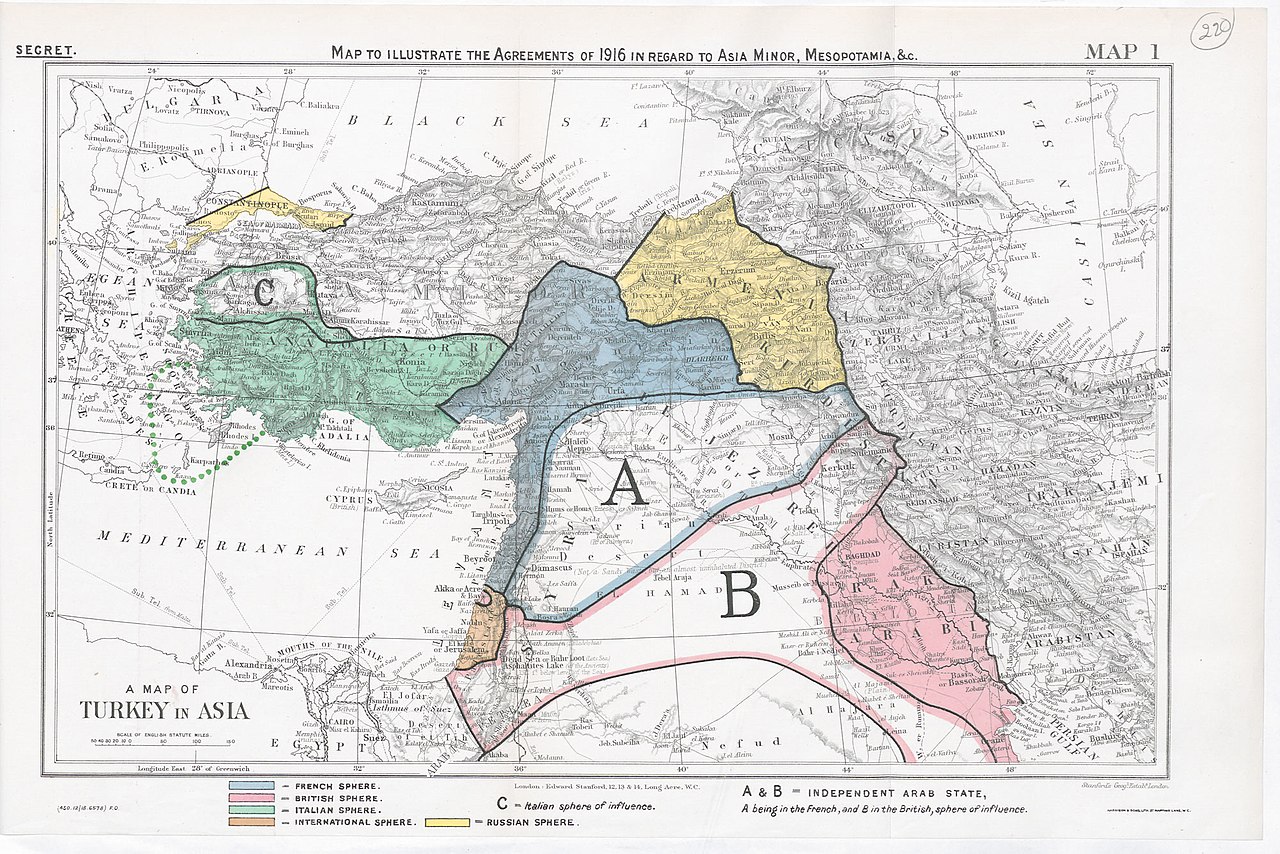
The Ottoman Empire's defeat in WWI on Germany's side led Britain and France to partition its Middle Eastern territories. Almost every modern Middle Eastern border and conflict traces back to this collapse.
On August 11, the Weimar constituent assembly adopted the Weimar Constitution, founding Germany's first republic — universal suffrage, proportional representation. Battered by Versailles humiliation and economic chaos, it ended in 1933.
In January 1919, representatives of 32 countries gathered in Paris for the peace conference, led by the Big Four (US, UK, France, Italy). Six months of negotiations produced the Treaty of Versailles and other settlements.
圖:David Lloyd George, Woodrow Wilson and Georges Clemenceau · Public domain · Wikimedia CommonsImage: David Lloyd George, Woodrow Wilson and Georges Clemenceau · Public domain · Wikimedia Commons
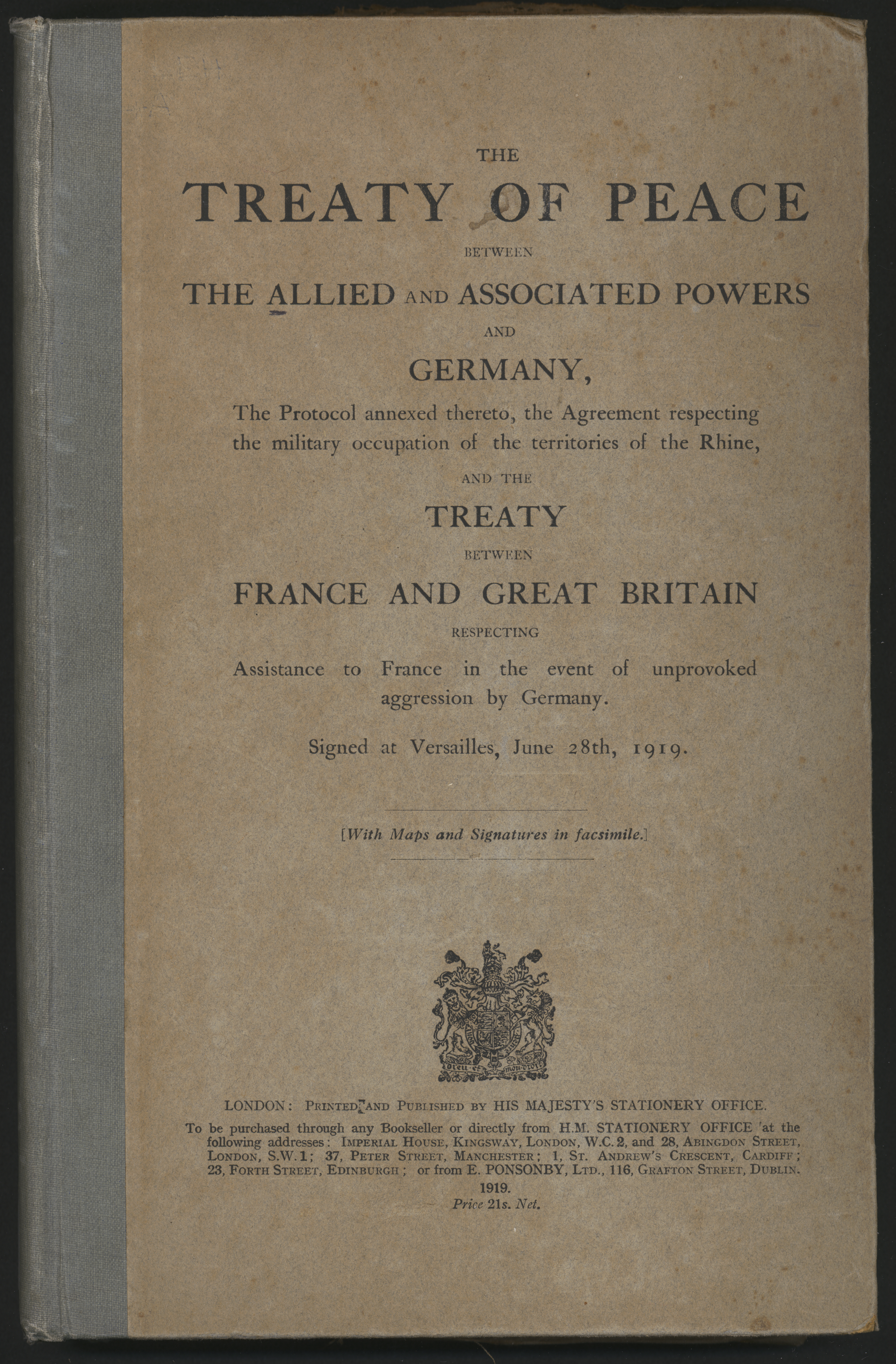
1919/6/28 Sarajevo 刺殺 5 週年,德於 Versailles 鏡廳簽屈辱條約:失 13% 領土、付賠款、限軍;埋二戰禍根。
On Jun 28, 1919 (5 years after Sarajevo), Germany signed the harsh Versailles Treaty in the Hall of Mirrors: 13% territory lost, reparations, army limits—seeding WWII.
圖:Edward N. Jackson (US Army Signal Corps) · Public domain · Wikimedia CommonsImage: Edward N. Jackson (US Army Signal Corps) · Public domain · Wikimedia Commons
Signed June 28 (five years after Sarajevo). Germany lost 13% of its territory and all colonies, its army was capped at 100,000, and it owed 132 billion gold marks in reparations. The humiliation laid seeds for Nazi rise.